
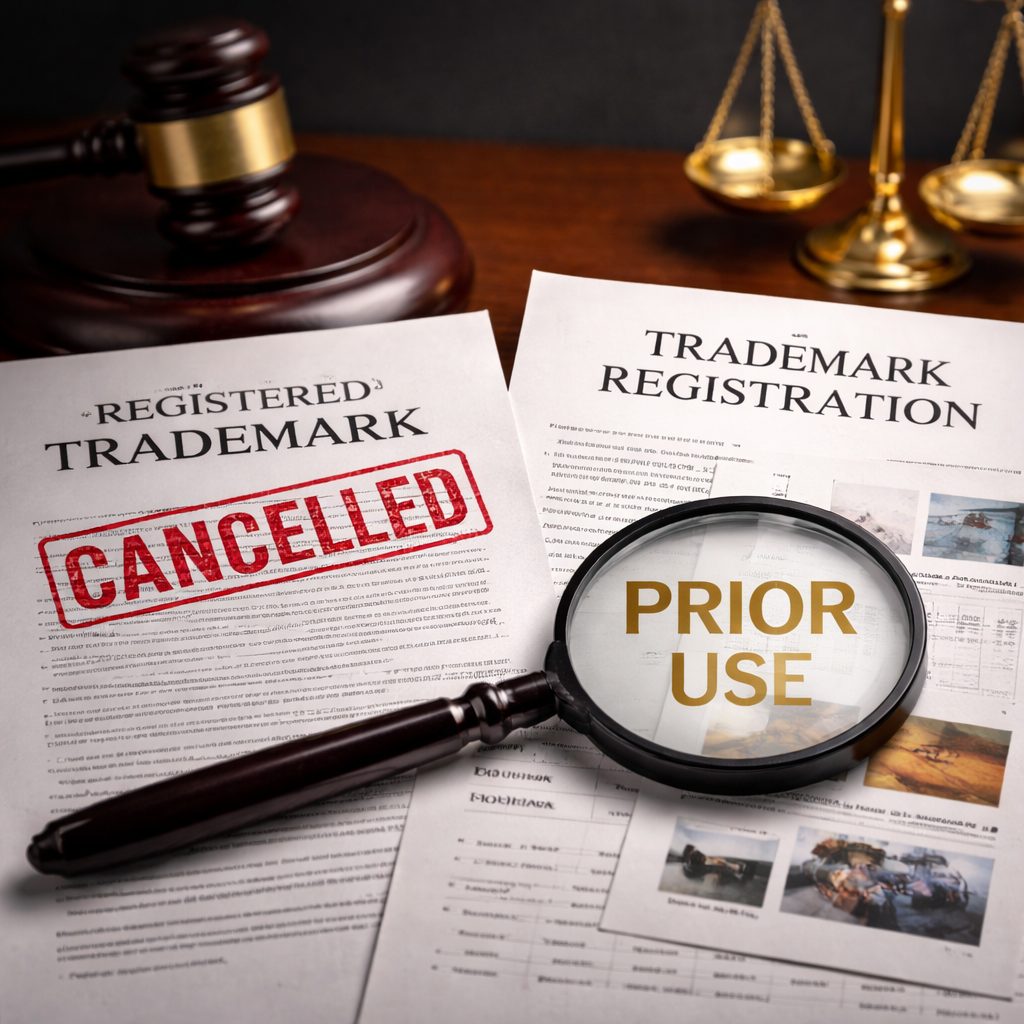
If a competitor has registered a trademark that conflicts with your business name, you may assume you’ve lost the right to use it.
That is not necessarily true.
Under U.S. trademark law, priority is based on use in commerce—not just who filed first. If you were using the name in your business before your competitor, you may have the legal right to cancel their federal trademark registration.
This is one of the most important—and misunderstood—areas of trademark law.
The Key Principle: Trademark Rights Come From Use, Not Registration
Trademark rights in the United States are generally established through actual use in commerce.
That means:
- You do not need a registration to have rights
- A later registrant can still be challenged
- Earlier use can override a federal registration
If your competitor filed first but you used the name first, you may have superior rights.
What Is a Trademark Cancellation Proceeding?
A trademark cancellation is a legal action filed with the Trademark Trial and Appeal Board (TTAB)—a division of the United States Patent and Trademark Office (USPTO).
The goal is simple:
Remove a registered trademark from the federal register.
One of the most common legal grounds for cancellation is priority of use.
When Can You Cancel a Trademark?
You may have grounds to cancel a registered trademark if:
- You used the mark in commerce before the registrant’s priority date
- The marks are confusingly similar
- The goods or services are related or overlapping
If those elements are met, you may be able to invalidate the registration entirely.
What Counts as “Use in Commerce”?
This is where most cases are won or lost.
“Use in commerce” means real, public-facing business activity, not just planning or reserving a name.
Qualifying use typically includes:
- Selling goods under the mark
- Providing services using the name
- Advertising or marketing tied to the brand
- Website use offering goods or services
- Customer-facing branding tied to transactions
The mark must function as a source identifier—meaning customers associate it with your business.
What Evidence Do You Need to Prove Prior Use?
A cancellation claim is only as strong as the evidence supporting it.
You should be prepared to provide:
- Invoices and sales records
- Website screenshots (dated)
- Advertising materials
- Social media posts tied to business activity
- Business formation and operational records
- Customer communications or contracts
No proof = no case.
Documentation is critical.
Why Timing Matters in Trademark Cancellation
Trademark disputes are highly time-sensitive.
The longer a conflicting mark remains registered and in use:
- The more entrenched it becomes
- The harder it can be to challenge
- The more expensive enforcement becomes
Early action preserves leverage.
Risks of Ignoring a Conflicting Trademark
If you do nothing, you risk:
- Losing control over your brand
- Consumer confusion in the marketplace
- Being blocked from expanding your business
- Facing enforcement action from the registrant
- Being forced to rebrand
In some cases, the registrant may attempt to enforce their trademark against you—even if you used the name first.
Why Trademark Strategy Matters
A trademark cancellation is not just a filing—it is a litigated administrative proceeding.
Success depends on:
- Clear proof of prior use
- Strong legal positioning
- Proper timing
- A structured evidentiary record
Handled correctly, a cancellation can restore your ability to operate under your brand and eliminate a competing registration.
The Bottom Line
If you used a name first in commerce, you may still have the right to challenge and cancel a competitor’s trademark—even if they registered it before you.
But success depends on evidence, timing, and strategy.
Protect Your Brand the Right Way
If you believe a competitor has registered a trademark that conflicts with your prior use, you should evaluate your legal position before taking action.
Nathan Moore is a trademark attorney located in Nashville. Moore Law PC helps individuals and businesses successfully apply for and register trademarks nationwide.
Moore Law PC
615 Main Street
Nashville, TN 37206
Schedule a consultation at https://MooreTrademarks.com
Frequently Asked Questions (FAQ)
Can I cancel someone else’s trademark if I used the name first?
Yes. If you can prove prior use in commerce and likelihood of confusion, you may be able to cancel their registration.
What is the TTAB?
The Trademark Trial and Appeal Board (TTAB) is the administrative body that handles trademark disputes, including cancellations and oppositions.
What evidence is required to prove prior use?
Common evidence includes sales records, invoices, website screenshots, advertising materials, and business documentation showing commercial use.
Is trademark registration required to have rights?
No. In the U.S., trademark rights are generally based on use in commerce, not just registration.
How long do I have to cancel a trademark?
It depends on the grounds, but certain claims (like priority) can be brought even after registration, while others are time-limited.
What happens if I lose a cancellation case?
The registration remains in place, and the registrant may have stronger grounds to enforce their trademark against you.

