
What Makes a Good Contract? Why ChatGPT Is Not Enough for Real Legal Protection
Many business owners now use AI tools to draft contracts.
That makes sense. Tools like ChatGPT can generate contract language quickly. They can organize ideas, clean up rough notes, and produce a document that looks polished.
But that creates a real risk.
A contract that sounds professional is not always a good contract.
When a deal matters, ChatGPT is not enough by itself. A strong contract does more than use formal language. It protects the business relationship, reduces risk, and gives you leverage if something goes wrong.
What Makes a Good Contract?
A good contract clearly explains the deal and protects the parties if the deal breaks down.
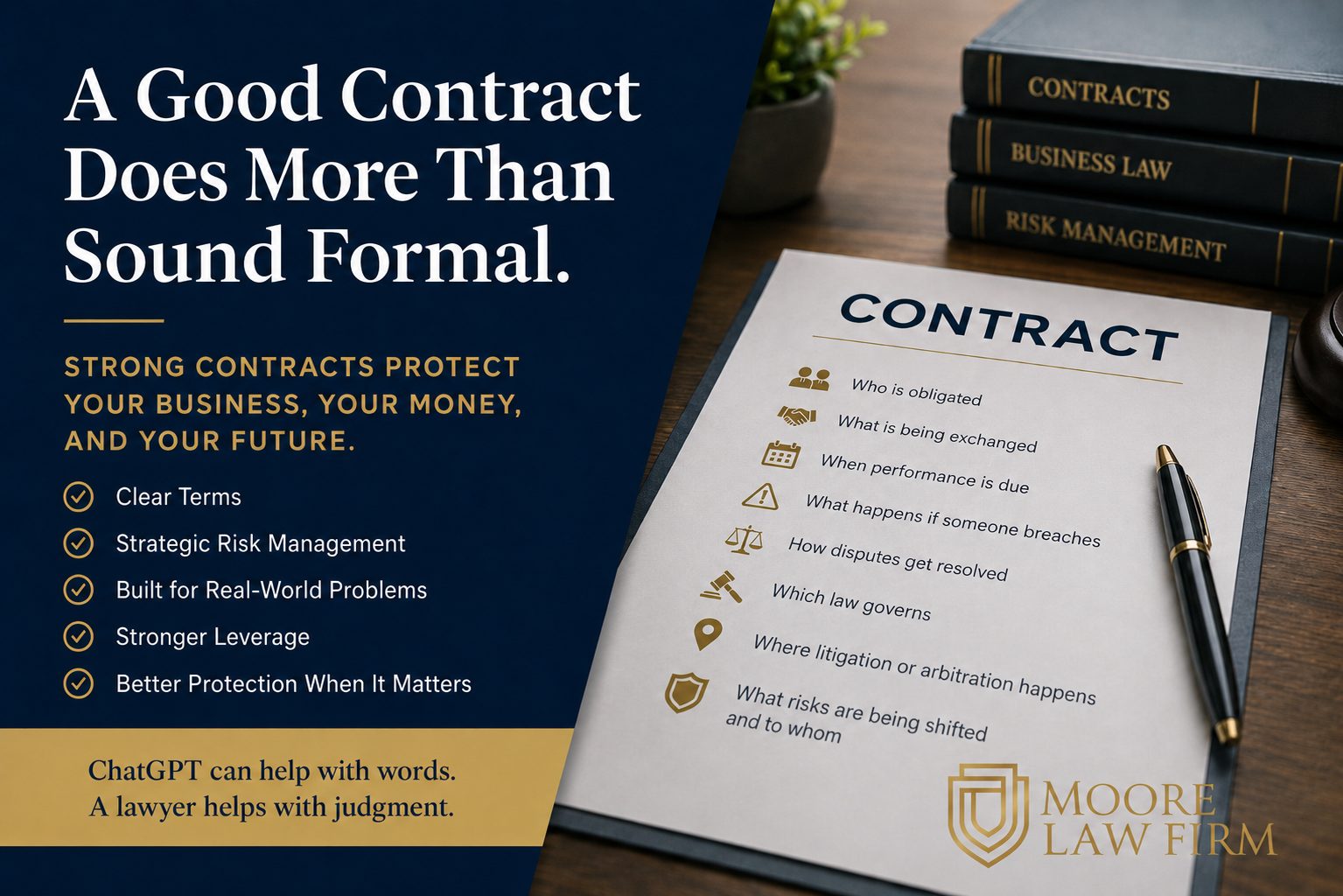
At a basic level, a strong contract should identify:
- Who is responsible for doing what
- What is being exchanged
- When payment or performance is due
- What happens if someone breaches the agreement
- How disputes will be handled
- Which state’s law applies
- Where litigation or arbitration will take place
- What risks are being shifted and to whom
These details matter because contracts are not just paperwork. They are risk-management tools.
A good contract should be clear enough to guide the parties while things are going well and strong enough to protect you when there is conflict.
A Good Contract Is Strategic, Not Just Polished
The best contracts do not simply sound legal. They reflect the actual business deal.
A well-drafted contract should:
- Match the real agreement between the parties
- Allocate risk on purpose
- Close loopholes before they become problems
- Protect the client’s leverage
- Anticipate what can go wrong
- Provide a practical path forward if there is a dispute
That is where legal judgment matters.
ChatGPT can help generate text. It can help brainstorm contract terms. It may even point out some common issues.
But AI does not automatically understand the business reality behind the deal.
Why ChatGPT Is Not Enough for Contract Drafting
ChatGPT can produce language, but contract drafting is not just a writing task.
A contract may look complete and still fail to protect you. The problem is that AI does not know the full context unless a person provides it. Even then, it may miss legal or strategic issues that matter.
For example, ChatGPT does not automatically know:
- The real facts behind the deal
- The leverage each side has
- The industry customs that matter
- The hidden risks in the transaction
- The local law issues that may affect enforcement
- How a vague clause could later be used against you
- Which issues are worth negotiating and which are not
Those are not just drafting questions. They are legal strategy questions.
Contracts Are Risk-Management Tools
A strong business contract is built around the actual business objective and the actual legal exposure.
It should be drafted with a clear understanding of where the deal could fail. That may include missed payments, delays, poor performance, confidentiality problems, ownership disputes, termination issues, or one party trying to avoid responsibility.
A good contract asks hard questions before problems happen.
- What if the other party does not pay?
- What if deadlines are missed?
- What if the work is rejected?
- What if the relationship ends early?
- What if confidential information is misused?
- What if one side tries to use vague wording to its advantage?
These are the issues that determine whether a contract actually protects you.
The Difference Between AI Drafting and Legal Drafting
AI can help with wording. A lawyer helps with judgment.
Legal drafting usually involves more than producing clean language. It often requires:
- Spotting legal and business issues
- Understanding the risks in the transaction
- Structuring the agreement around the client’s goals
- Deciding what terms should be negotiated
- Knowing how a clause may be enforced later
- Protecting the client if the relationship becomes disputed
A contract is not measured by how polished it sounds. It is measured by how well it protects the client when there is pressure, conflict, money at stake, or a dispute later.
That is the difference.
The Danger of a Contract That “Looks Fine”
One of the biggest problems with AI-generated contracts is false confidence.
A weak contract can still look clean, organized, and professional. That is what makes it dangerous.
The problems often do not appear when the contract is signed. They show up later, when enforcement matters.
That may happen when:
- A payment is missed
- A deal falls apart
- A deadline is ignored
- A customer refuses to perform
- A vendor does poor work
- A business partner changes position
- One party reads a vague clause in the most self-serving way possible
That is when contract quality gets tested.
If the contract is unclear, incomplete, or poorly structured, the polished language may not help much.
When Should a Lawyer Review a Contract?
A lawyer should review or draft a contract when the deal involves meaningful money, ongoing obligations, business risk, intellectual property, confidential information, ownership rights, liability exposure, or the possibility of a future dispute.
In simple terms: if the deal matters, the contract matters.
AI may be useful as a starting point, but a lawyer can help identify what the contract should actually say, what it should not say, and what protections may be missing.
Can ChatGPT Help With Contracts?
Yes. ChatGPT can be helpful when used carefully.
AI tools can help:
- Organize contract ideas
- Create a rough first draft
- Explain common contract sections
- Suggest topics to discuss with a lawyer
- Improve readability
But AI should not be treated as a substitute for legal advice.
Used correctly, AI can support drafting. Used carelessly, it can create false confidence.
Strong Contracts Require Legal Strategy
If the deal matters, if the money matters, or if the risk matters, you need more than text generation.
You need legal strategy.
A good contract should be built around your business goals, your risk tolerance, your leverage, and the practical problems that could arise if the deal goes sideways.
That is not just writing. That is legal work.
Need Help With a Business Contract?
Moore Law PC helps business owners with contracts, trademarks, LLC structure, and legal strategy.
If you want help building stronger business agreements, message us or call (615) 747-7467.
Nathan Moore is an attorney and founder of Moore Law PC, where he helps business owners protect their businesses through practical legal strategy.
Frequently Asked Questions
What makes a contract legally strong?
A legally strong contract clearly identifies the parties, their obligations, payment terms, deadlines, breach consequences, dispute process, governing law, and risk allocation. It should also reflect the actual business deal and anticipate what may go wrong.
Can ChatGPT write a contract?
ChatGPT can generate contract language, but it does not replace legal advice. It may help create a rough draft, organize terms, or explain common contract sections, but it may miss legal risks, local law issues, negotiation concerns, or important protections.
Is an AI-generated contract enforceable?
An AI-generated contract may be enforceable if it meets the legal requirements for a valid contract. However, enforceability does not mean the contract is well drafted, complete, or protective. A contract can be legally valid and still be bad for your business.
Why should a lawyer review a contract?
A lawyer can identify missing terms, unclear language, legal risks, enforcement issues, and business problems that may not be obvious from the wording alone. Legal review helps make sure the contract protects your interests before there is a dispute.
When is ChatGPT not enough for a contract?
ChatGPT is not enough when the contract involves significant money, business risk, intellectual property, confidential information, long-term obligations, liability exposure, or a relationship where a dispute could seriously harm the business.

