The Smart Way to Name Your Product—And Protect It Legally
A great name won’t protect itself. Watch to learn how to choose a product name that’s unique, legally strong, and built to last.

A great name won’t protect itself. Watch to learn how to choose a product name that’s unique, legally strong, and built to last.
A word mark protects the name of your business, product, or service in plain text—regardless of how it looks. If you register the name “Sunny Apples” as a word mark, you own the rights to those words, no matter what font, size, or color you use.
This type of trademark gives you broad protection because your rights apply to the name itself, not how it’s styled.
A design mark protects the visual elements of your brand, like your logo or a unique symbol. If your business is recognized by a distinctive image, you’ll want to protect it with a design mark.
Think of famous design marks like the Nike swoosh or the McDonald’s golden arches—those visuals are just as valuable as the names behind them.
A composite mark protects both your name and logo together as a single unit. This is useful if your brand consistently uses a combination of words and a specific design layout.
For example, if your logo always includes your company name in a particular font next to a graphic, a composite mark protects that specific combination.
Word marks usually offer the strongest and most flexible protection. That’s because it’s harder for someone to get around using similar words than it is to slightly change a logo.
Composite marks and design marks still offer valuable protection, but if you have to choose, a word mark is often the best place to start.
If your budget allows, registering your word mark, design mark, and composite mark provides the most complete protection. But if you need to prioritize:
Word marks give you legal protection for your brand name no matter how it’s displayed. If your logo evolves over time or you want to use your brand name across different media, a word mark ensures you’re still covered.
If your logo is a big part of how customers recognize you, a design mark helps keep competitors from using something similar. It gives you control over the visual look of your brand, not just the words.
A composite mark protects the combination of your name and logo used together. This is ideal for brands with a specific, consistent layout that customers associate with the business.
Let’s say you own “Green Valley Farms,” which sells organic dairy. You might:
This strategy gives you full protection—covering the name, the logo, and the way they appear together.
Choosing the right trademark type depends on your brand, your goals, and your budget. If you’re ready to register or just need some guidance, reach out to us, either by chat on the website or phone at (615) 747-7467.
Nathan Moore is the founder of Moore Law PC, a business law firm based in Nashville, Tennessee. He has practiced law for more than 20 years, advising entrepreneurs and companies on matters involving trademark registration, business formation, contracts, and commercial disputes.
Mr. Moore is licensed to practice in all Tennessee state courts, as well as the United States District Court for the Middle District of Tennessee and the United States Court of Appeals for the Sixth Circuit.
He earned his Juris Doctor from George Mason University School of Law and holds a Bachelor of Arts in Economics from Vanderbilt University.
His articles explain business and intellectual property topics in plain English so business owners can make informed decisions.
Last reviewed by Nathan Moore, Attorney at Law — December 2025
.
Last updated: October 2025
Your brand name, logo, and slogan are more than creative assets—they’re the reputation you’ve built. Without protection, another business might use something confusingly similar and dilute your goodwill. That’s why many owners choose a trademark attorney in Jacksonville to help secure their rights.
This guide explains what trademark attorneys do, why registration matters, and how the process works for Florida businesses.
A trademark attorney helps you protect the identifiers that make your business unique—names, logos, and slogans.
A knowledgeable Jacksonville trademark lawyer can align your protection with your growth plans, including expansion, licensing, or franchising.
While the USPTO lets you file on your own, many applications are delayed or refused for avoidable issues. Consider hiring an attorney when:
Local counsel offers face-to-face strategy and an understanding of Florida business realities. A trademark attorney in Jacksonville can coordinate state and federal protection so your rights match how and where you operate.
Most growing companies choose federal registration for nationwide protection and stronger enforcement. State registration can be useful if you operate only within Florida.
Many applications take 8–12 months from filing to registration, depending on USPTO workload and whether any objections or refusals arise.
Yes, but self-filed applications are often refused for avoidable errors. An attorney reduces those risks and handles office actions.
No. Forming an entity does not create trademark rights. Rights come from use in commerce, and federal registration strengthens those rights.
Names, logos, slogans, and sometimes packaging or sounds—if they identify your business as the source of goods or services.
“TM” can be used for an unregistered mark. The ® symbol is reserved for federally registered trademarks.
Whether you’re starting up or rebranding, protect what makes your business unique. A qualified trademark attorney in Jacksonville can guide you through searches, filing, and enforcement so your brand is secure as you grow.
Last updated: October 2025
Your brand name, logo, and slogan are more than creative assets—they represent your reputation. Without proper protection, another business could use something similar and confuse your customers. That’s why many business owners turn to a trademark attorney in West Palm Beach for help.
This article explains what trademark attorneys do, why registration matters, and how the process works for Florida businesses.
A trademark attorney helps business owners protect the names, logos, and other brand identifiers that make their company unique.
A knowledgeable West Palm Beach trademark lawyer ensures your brand is protected under both federal and Florida law.
While the USPTO allows business owners to file their own applications, many are delayed or denied for simple mistakes. You should contact a trademark attorney when:
Working with a local attorney means face-to-face strategy and a lawyer who understands the needs of Florida businesses. A local trademark attorney in West Palm Beach can also coordinate protection under both state and federal law, giving you broader coverage and peace of mind.
Federal registration offers nationwide protection and stronger enforcement tools. Florida state registration can be useful for purely in-state operations, but most growing businesses prefer federal protection.
Many applications take about 8–12 months from filing to registration, depending on USPTO workload and whether any objections arise.
Yes, you can file on your own. But many applications are refused for avoidable errors in search, classes, or specimen. An attorney reduces those risks and handles office actions.
No. Forming an LLC or corporation doesn’t create trademark rights. Trademark rights come from using a mark in commerce, and registration strengthens those rights.
Names, logos, slogans, and in some cases product packaging or sounds—so long as they uniquely identify your business as the source.
“TM” can be used to claim rights in an unregistered mark. The ® symbol is reserved for federally registered trademarks.
Talk to an attorney. You may need a monitoring strategy, a cease-and-desist letter, or—in some cases—an opposition or infringement action.
A trademark attorney helps business owners protect their brand identity — names, logos, slogans, and even product designs.
Many entrepreneurs file applications themselves, but the USPTO rejects many for avoidable errors. You should hire a trademark lawyer when:
Working with a local Milwaukee trademark lawyer offers advantages like familiarity with Wisconsin business law, local courts, and in-person strategy sessions.
No, but federal registration gives stronger, nationwide protection.
Yes. Slogans, logos, and even sounds can be trademarked if they uniquely identify your business.
Most applications take 8–12 months from filing to registration, depending on USPTO review.
Your brand is more than a name — it’s the goodwill you’ve built over time. Working with an experienced trademark attorney in Milwaukee ensures your business identity is protected from the start.
A trademark search ensures your brand is unique and not infringing on someone else’s rights. It’s more than just checking Google. The U.S. Patent and Trademark Office (USPTO) database, state registries, and even common law sources should all be part of your search.
Don’t rely on exact matches. Many refusals come from confusingly similar marks, not identical ones. Consider hiring a trademark attorney or search service if your brand is critical to your business growth.
Yes. A search helps avoid conflicts and increases the chance of approval. Skipping this step can lead to wasted time and money.
Not always. The USPTO search is a starting point, but it won’t cover state trademarks or unregistered “common law” uses that can still block your mark.
They may still have enforceable rights under common law. That’s why broad searches beyond the USPTO are critical.
A basic search may take an hour, while a comprehensive attorney-led search can take several days depending on the complexity.
That said, basic isn’t always better and can cause complications with your registration down the road. The trademark process already takes forever (forever or 12-14 months). You don’t want to extend the wait unnecessarily.
An ounce of prevention is worth a pound of cure.
Penny wise, pound foolish.
You get the idea.
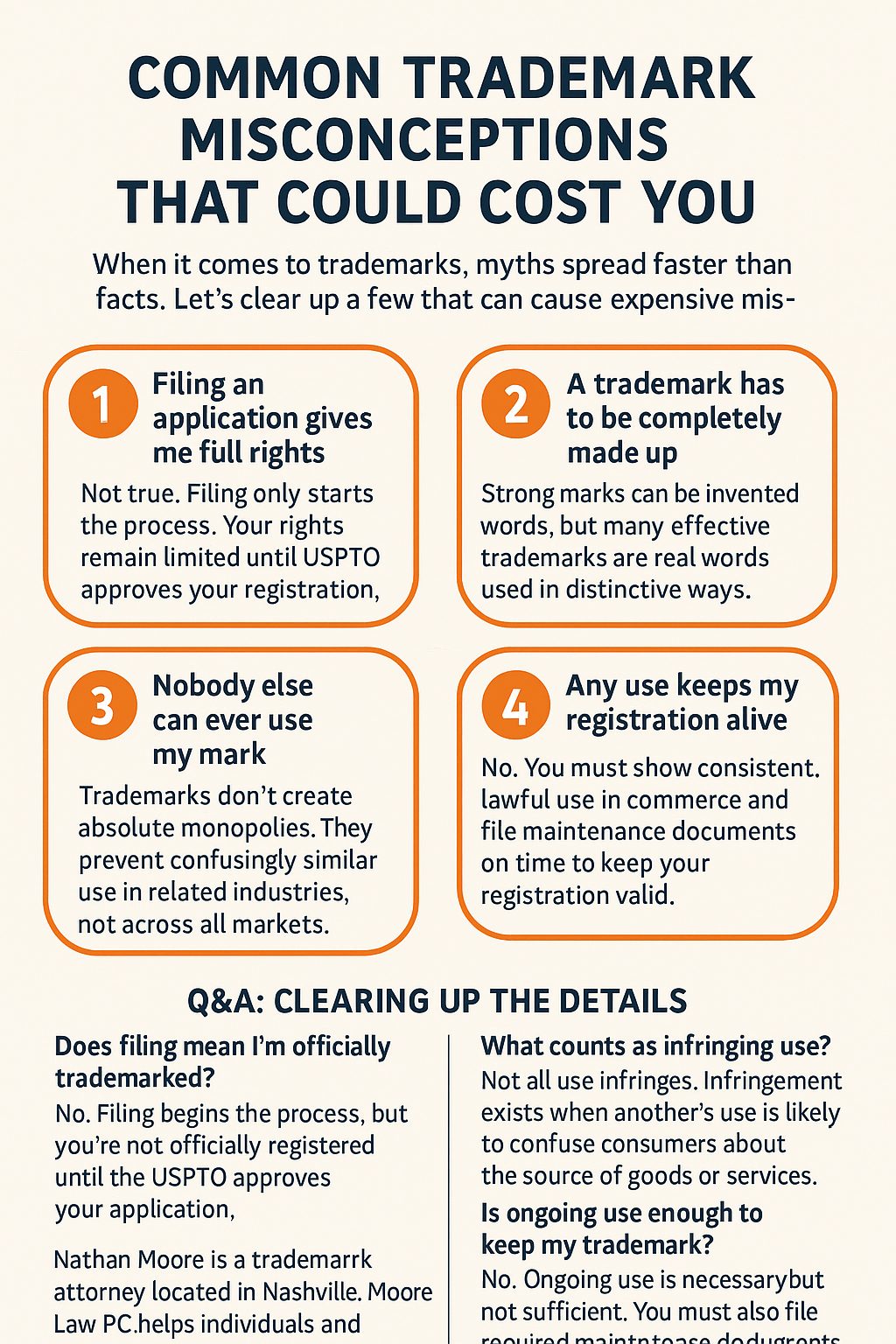
Trademarks protect reputation and reduce confusion. But myths about what trademarks do—and do not do—often lead to costly mistakes. Here is a fast, plain-English reset so you can file and maintain your rights with confidence.
False. Filing starts the process, but you are not federally registered until the USPTO approves your application. Until then, your protection is limited.
No. Invented words can be strong, but real words used in distinctive or arbitrary ways can be strong too. What matters is distinctiveness, not novelty alone.
It does not. Trademarks stop confusingly similar use in related goods or services. Unrelated industries may coexist if there is no likely confusion.
Use must be lawful and continuous, and you must file required maintenance (Sections 8/9) on time. Miss those filings and your registration can be cancelled.
Does filing mean I am officially trademarked?
No. Filing begins examination. You are officially registered only after the USPTO approves and issues the registration.
Do I need to invent a word for a strong mark?
Not required. Arbitrary or suggestive uses of real words can be strong. Descriptive terms face hurdles unless they gain distinctiveness.
What counts as infringing use?
Use that is likely to confuse consumers about the source, sponsorship, or affiliation of goods or services.
Is ongoing use enough to keep my registration?
You need both continued, lawful use and timely maintenance filings (Sections 8 and 9). Missing deadlines risks cancellation.
Trademark law is full of nuance, and relying on myths can leave your business exposed. A strong trademark strategy requires more than assumptions—it takes accurate knowledge, clear planning, and careful execution. By separating fact from fiction, you protect your brand, minimize disputes, and position yourself for long-term growth. Don’t leave your intellectual property to chance—take proactive steps to secure it the right way from the start.
Nathan Moore is a trademark attorney located in Nashville. Moore Law PC helping individuals and businesses successfully apply for and register trademarks nationwide.
Before you invest in a new name or logo, search first. A proper trademark search goes beyond a quick web query. It looks at federal and state registers, plus unregistered (common-law) uses in the marketplace. That extra diligence can prevent refusals, disputes, and costly rebrands.
Is a Google search enough?
No. Google is a start, but you must check the USPTO register, state databases, and common-law uses to catch conflicts.
Do spelling tweaks avoid conflicts?
Not necessarily. Sound-alikes or similar meanings can still confuse customers and draw refusals.
Should I search logos, too?
Yes. Design marks can conflict even when words differ. Search word and design marks together.
If I only sell locally, do I still need a federal search?
Yes. Federal rights can impact your local use, and online sales erase geographic boundaries quickly.
Nathan Moore is a trademark attorney located in Nashville. Moore Law PC helps individuals and businesses successfully apply for and register trademarks nationwide.

Most trademark applications fail for one simple reason: the specimen doesn’t prove real-world use. A specimen is your evidence—what the customer sees when they meet your brand in the wild. Get it right, and your filing moves. Get it wrong, and you lose time and money.
What counts as a valid specimen for goods?
Labels, packaging, hangtags, product photos with the mark, or a live product page with price and a way to order.
What works for services?
Ads, brochures, or website pages that show the mark and clearly offer the services with contact or booking details.
Can I use a website screenshot?
Yes—if it shows the mark plus real buying or hiring signals (price, cart, checkout, order or booking instructions).
Are mockups or “coming soon” pages okay?
No. The USPTO needs current use in commerce, not plans or previews.
What if I’m not selling yet?
File Intent‑to‑Use now and submit your specimen later once sales or services begin.
Delays are what you want to avoid is trademark registration. The process is long enough when everything goes perfectly. Experience counts and knowing what specimens are acceptable will, and most importantly, will not work, avoid problems from the start.
Nathan Moore is a trademark attorney located in Nashville. Moore Law PC helps individuals and businesses successfully apply for and register trademarks nationwide.


