Smartphone with marketing text message beside legal symbols and Texas graphic illustrating SMS marketing compliance risks and penalties

SMS Marketing Compliance: Why It Matters, How Texas Law Complicates It, and the Penalties Businesses Face

SMS marketing can be one of the most effective ways for a business to reach customers. Text messages are direct, fast, and often opened within minutes. But that same immediacy creates legal risk. If a business sends promotional texts without proper consent, ignores opt-out requests, or fails to follow state-specific rules, the consequences can be expensive.

That is why SMS marketing compliance matters. It is not just a technical issue for the marketing team. It is a legal issue that can affect the entire business.

For companies that market by text message, the risk is not limited to federal law. Texas has added another layer of complexity by expanding its telemarketing framework in a way that can affect SMS campaigns. As a result, all businesses that text Texas consumers need to think carefully about how they collect consent, manage opt-outs, and document compliance.

Why SMS Marketing Compliance Is So Important

At a basic level, SMS marketing compliance is about permission and proof.

Before sending a promotional text, a business should be able to answer a few simple questions. Did the recipient agree to receive marketing texts? Was that consent clearly obtained? Can the business prove it? Is there a reliable process for handling opt-out requests?

Those questions matter because text marketing laws are designed to protect consumers from unwanted contact. A campaign may look harmless from a business perspective, but if the company cannot show valid consent or continued texting after a recipient opted out, the risk can grow quickly.

Strong compliance practices also help protect customer trust. Consumers are much more likely to respond positively to text marketing when they feel they have control over what they receive. When a business texts the wrong people or keeps messaging after a stop request, the damage is not only legal. It can hurt the brand as well.

Federal Law Already Creates Major Exposure

Businesses often focus first on federal law, especially the Telephone Consumer Protection Act, or TCPA. That makes sense. Marketing text messages can fall within the same general legal framework that applies to certain unwanted calls, and the potential financial exposure can be significant.

The TCPA allows consumers to bring claims for statutory damages. Those damages can be $500 per violation, and they can rise to $1,500 per violation for willful or knowing violations.

That is where SMS campaigns become dangerous for businesses that do not have a solid compliance system. One message may not sound like much, but large campaigns involve volume. If a company sends hundreds or thousands of texts without valid consent, the numbers can become serious very quickly.

The Texas Law That Makes SMS Compliance More Complicated

Texas has made SMS marketing compliance more difficult by expanding the meaning of telephone solicitation under state law.

That matters because businesses sometimes assume text messaging is governed only by federal rules or by broad consent principles. In Texas, that assumption can create problems. The state has taken a broader view that can bring marketing texts more directly into telemarketing regulation.

For businesses that text Texas consumers, this creates a more complicated compliance picture. It is no longer enough to ask whether a campaign generally follows federal law. Businesses also need to consider whether Texas rules create additional obligations or additional exposure.

Why Texas Businesses and Out-of-State Marketers Should Pay Attention

The Texas change is important for both Texas businesses and companies located outside Texas that market to Texas residents.

Once a marketing text falls within the Texas telemarketing framework, a business may need to think about issues such as registration, disclosures, internal procedures, consent standards, and no-call compliance. Even when a company believes it has addressed one part of the law, another compliance issue may still remain.

This is where many businesses get into trouble. They rely on a texting platform, use generic signup language, or copy consent language from another company without reviewing whether it actually fits their campaign. They may also assume that if a consumer initially agreed to receive messages, the compliance analysis ends there. It does not.

SMS compliance is an ongoing process. It includes how consent is collected, how records are stored, how messages are sent, how opt-outs are handled, and whether state-specific rules have been reviewed.

What Penalties Can Result From Violating SMS Marketing Laws?

The penalties for violating SMS marketing laws can be substantial.

Under federal law, a business may face $500 per violation or up to $1,500 per violation for willful or knowing conduct. If a campaign reaches a large list, the financial exposure can multiply quickly.

Texas can increase the pressure even more. In addition to federal risk, businesses may face civil penalties of up to $5,000 per violation under Texas law. Depending on the facts, there may also be private litigation risk, regulatory scrutiny, and class action exposure.

That means a single noncompliant campaign can create several layers of liability at the same time. A business may face claims based on consent problems, texting after an opt-out, noncompliant procedures, or failure to account for state-specific requirements.

Common SMS Marketing Compliance Mistakes

Using weak or unclear consent language

If consent language is vague, incomplete, or poorly documented, it may be difficult to defend later.

Failing to honor opt-out requests

A stop request should trigger immediate internal action. Continuing to text after an opt-out can create major risk.

Relying too heavily on vendors

Using a third-party texting platform does not eliminate legal responsibility. The business sending the campaign still needs to understand how the system works.

Ignoring state-specific rules

Federal compliance is important, but it is not always enough. Texas is a good example of why a state-law review matters.

Keeping poor records

If consent cannot be proven, it may be as if it never existed from a litigation standpoint.

Why a Compliance Review Is Worth It

A compliance review can often identify risk before it becomes a lawsuit or enforcement issue.

For businesses that use SMS marketing, a review can help answer critical questions about consent, recordkeeping, opt-out handling, campaign structure, and Texas-specific exposure. It can also reveal whether the business is relying on outdated forms, workflows, or vendor assumptions.

In many cases, fixing these issues early is far less expensive than defending a legal claim later.

FAQ: SMS Marketing Compliance

What is SMS marketing compliance?

SMS marketing compliance means following the laws and rules that apply to promotional text messages. That usually includes obtaining proper consent, honoring opt-out requests, and reviewing both federal and state requirements.

Why is Texas law a concern for SMS marketers?

Texas has expanded its telemarketing rules in a way that can apply to text message marketing. That adds another layer of legal risk for businesses that text Texas consumers.

What are the penalties for violating SMS marketing laws?

Potential penalties may include $500 per violation under federal law, up to $1,500 per violation for willful or knowing violations, and up to $5,000 per violation under Texas law.

Is federal compliance enough for Texas SMS marketing?

Not always. A business may believe it is compliant under federal law but still face risk under Texas law.

How can a business lower its SMS marketing risk?

The best place to start is with a compliance review of consent language, opt-out procedures, recordkeeping, and campaign practices.

Schedule a Compliance Review

If your business uses promotional text messages, now is the time to review your SMS marketing practices. A compliance review can help identify gaps in consent language, opt-out procedures, documentation, and Texas-specific exposure before they turn into expensive problems.

About the Author

Nathan Moore is the founder of Moore Law PC, a business law firm based in Nashville, Tennessee. He has practiced law for more than 20 years, advising entrepreneurs and companies on matters involving trademark registration, business formation, contracts, and commercial disputes. Mr. Moore is licensed to practice in all Tennessee state courts, as well as the United States District Court for the Middle District of Tennessee and the United States Court of Appeals for the Sixth Circuit. He earned his Juris Doctor from George Mason University School of Law and holds a Bachelor of Arts in Economics from Vanderbilt University. His articles explain business and intellectual property topics in plain English so business owners can make informed decisions.

Read More
Attorney signing a cease and desist letter with Nashville skyline and Tennessee State Capitol in background representing business dispute resolution in Tennessee

How Do I Send a Cease and Desist Letter in Tennessee?

When someone is harming your business—whether through defamation, contract interference, intellectual property misuse, harassment, or unfair competition—you may not need to file a lawsuit right away. In many cases, the first step is sending a cease and desist letter.A properly drafted cease and desist letter can stop harmful behavior quickly, preserve evidence, and protect your legal position. But it must be done carefully. An aggressive or poorly written letter can escalate the situation or weaken your leverage.

What Is a Cease and Desist Letter?

A cease and desist letter is a formal written demand that someone stop specific conduct. It outlines:

  • What the person or business is doing
  • Why the conduct is unlawful or harmful
  • What action must stop
  • What will happen if it does not stop

It is not a lawsuit. It is a warning and an opportunity to resolve the issue before litigation becomes necessary.

When Should You Send One?

Tennessee business owners commonly use cease and desist letters in situations such as:

  • Breach of contract
  • Violation of a non-compete or non-solicitation agreement
  • Defamation or false statements harming a business
  • Trademark or brand misuse
  • Copyright infringement
  • Harassment or interference with business relationships

In many cases, a formal legal demand is enough to correct the behavior. Many individuals and companies do not want the expense or publicity of a lawsuit.

Step 1: Confirm You Have Legal Grounds

Before sending anything, make sure you actually have a legal basis for your claim. A cease and desist letter should rely on:

  • A valid contract
  • Established intellectual property rights
  • Documented defamatory statements
  • Clear evidence of harmful conduct

Sending a letter without legal support can backfire. In some situations, it could expose you to counterclaims.

Step 2: Clearly Describe the Conduct

The letter should identify exactly what conduct must stop. Vague accusations are ineffective. A strong letter:

  • Lists dates and specific actions
  • References relevant contract provisions or legal rights
  • Explains how the conduct is causing harm

Clarity increases credibility and reduces the chance of misinterpretation.

Step 3: State What You Want to Happen

Your demand should be direct. For example:

  • Immediately stop using a business name
  • Remove defamatory online posts
  • Comply with a non-compete agreement
  • Return confidential information

You may also include a deadline for compliance.

Step 4: Explain the Consequences

A cease and desist letter typically states that failure to comply may result in legal action. This may include:

  • Filing a lawsuit
  • Seeking injunctive relief
  • Claiming damages
  • Requesting attorney’s fees where allowed

The tone should be firm but professional. The goal is compliance, not escalation.

Should an Attorney Send It?

You can draft and send a cease and desist letter yourself. However, when an attorney sends the letter on firm letterhead, it often carries more weight.

More importantly, a lawyer can:

  • Evaluate the strength of your claim
  • Avoid accidental admissions
  • Prevent overstatements that could harm your position
  • Ensure the letter aligns with Tennessee law

In many cases, the cost of having it done properly is far less than the cost of fixing a poorly handled dispute.

What Happens After You Send It?

There are typically three possible outcomes:

  • The recipient complies.
  • The recipient responds and negotiates.
  • The recipient ignores the letter.

If the conduct continues, your next step may be filing a lawsuit or seeking a court order. The cease and desist letter can serve as evidence that you attempted to resolve the issue before litigation.

Common Mistakes to Avoid

  • Making threats you cannot legally support
  • Using emotional or inflammatory language
  • Sending the letter without reviewing contracts
  • Posting the dispute publicly online

Strategic restraint is often more effective than aggressive language.

Protect Your Business the Right Way

If someone is harming your business, you do not have to ignore it. A properly drafted cease and desist letter may resolve the issue quickly and protect your rights.

Call (615) 747-7467 for an initial free consultation, or message us through our website to discuss your situation.

Disclaimer: This article is for general informational purposes only and is not legal advice.

Read More
Business owner holding LLC folder with Nashville skyline and Tennessee State Capitol representing single member LLC formation in Tennessee

Why a Single Owner Should Have an LLC in Tennessee

Many Tennessee entrepreneurs start their businesses alone. You may be a consultant, contractor, online seller, real estate investor, or service provider operating as a one-person company. A common question is: “If it’s just me, do I really need an LLC?”In most cases, the answer is yes. Even single-owner businesses face risk. Forming a Limited Liability Company (LLC) is often one of the simplest and most effective ways to protect yourself and build a strong legal foundation.

1. Protect Your Personal Assets

The biggest reason to form an LLC—even as a single owner—is liability protection.

If you operate as a sole proprietor, there is no legal separation between you and your business. If your business is sued, defaults on a contract, or causes financial harm, your personal assets may be at risk. That can include your personal bank accounts, vehicle, and even your home.

A properly formed and maintained Tennessee LLC creates a legal boundary between you and the business. While no structure guarantees total protection, an LLC significantly reduces personal exposure when operated correctly.

2. Look More Professional

Adding “LLC” to your business name can improve credibility. Customers, vendors, and banks often view LLCs as more established and legitimate than sole proprietorships.

This can help you:

  • Open business bank accounts
  • Secure contracts with larger clients
  • Obtain financing or lines of credit
  • Qualify for certain vendor relationships

Even if you are the only person involved, presenting your business as a formal legal entity can strengthen your brand.

3. Keep Business and Personal Finances Separate

One of the most important habits for any business owner is separating personal and business finances. An LLC encourages this structure.

With an LLC, you typically:

  • Open a dedicated business bank account
  • Use separate credit cards
  • Track income and expenses more clearly

This separation not only supports liability protection, but it also makes bookkeeping, tax preparation, and financial planning far easier.

4. Tax Flexibility as You Grow

A single-member LLC is typically taxed as a “disregarded entity” by default, meaning profits pass through to your personal tax return. However, as your income increases, you may have the option to elect S-corporation taxation if it becomes financially beneficial.

The advantage is flexibility. You can start simple and adjust your tax structure later as your revenue grows.

5. Clear Contracts and Legal Clarity

When you sign contracts personally, you are the legal party to the agreement. With an LLC, the company signs the contract—not you individually.

This distinction matters in:

  • Client service agreements
  • Commercial leases
  • Vendor contracts
  • Independent contractor agreements

Clear contracting reduces confusion about responsibility and can help limit personal liability exposure.

6. Prepare for Growth or Sale

Even if you plan to stay a solo operator, circumstances change. You may eventually:

  • Add a partner
  • Hire key employees
  • Bring in investors
  • Sell the business

Having an LLC in place makes these transitions smoother. It is much easier to add a member to an existing LLC than to restructure a sole proprietorship later.

7. Protect Your Business Name

When you register an LLC in Tennessee, you secure your business name at the state level. While this is not the same as federal trademark protection, it prevents another Tennessee entity from registering the exact same name.

That protection can be important as your reputation and online presence grow.

Common Mistakes Single Owners Make

  • Forming an LLC but continuing to use a personal bank account
  • Failing to create an operating agreement (even for a single member)
  • Signing contracts without clearly indicating the LLC name
  • Not maintaining proper records

To preserve liability protection, your LLC must operate like a real business—not an extension of your personal finances.

Is an LLC Right for You?

If you operate a one-person business in Tennessee, forming an LLC is often a smart step toward protecting your personal assets and strengthening your business foundation.

Moore Law PC helps Tennessee entrepreneurs form LLCs, draft operating agreements, and ensure their business structure supports long-term success.

Call (615) 747-7467 for an initial free consultation, or message us through our website to discuss forming your Tennessee LLC.


Disclaimer: This article is for general informational purposes only and is not legal or tax advice.

Read More
Attorney signing a business contract with Nashville skyline and Tennessee State Capitol in background representing strong contract drafting in Tennessee

How to Draft Strong Contracts in Tennessee

Contracts are the foundation of every successful Tennessee business. Whether you are hiring employees, working with independent contractors, leasing commercial space, or providing services to customers, a strong contract protects your time, money, and reputation.In simple terms, a contract sets clear expectations. When expectations are clear, disputes are less likely. And if a dispute does happen, a well-drafted agreement puts you in a much stronger position.

Start With Clear, Specific Terms

Vague language is one of the biggest reasons contracts fail. If your agreement says you will provide “marketing services,” that can mean many different things. Does that include social media? Paid ads? Email campaigns? How often? At what cost?

A strong Tennessee contract clearly answers:

  • What exactly is being provided?
  • When will it be delivered?
  • How much will it cost?
  • When and how will payment be made?

The more specific the terms, the less room there is for disagreement later.

Identify the Correct Legal Parties

Your contract must clearly identify who is entering the agreement. If you operate as an LLC or corporation, the contract should list the full legal name of the business—not just a trade name.

For example, if your company is registered as “Smith Consulting, LLC,” that exact name should appear in the contract. This helps preserve liability protection and avoids confusion about who is responsible for performance.

Using the wrong party name is a common mistake that can weaken your position if enforcement becomes necessary.

Define Payment Terms Clearly

Payment disputes are one of the most common business conflicts in Tennessee. Strong contracts clearly outline:

  • Total price or hourly rate
  • Deposit requirements
  • Payment deadlines
  • Late fees or interest
  • Responsibility for collection costs or attorney’s fees

If payment terms are unclear, courts may interpret them in ways you did not expect. Being detailed upfront often prevents problems entirely.

Include Termination Provisions

Not every business relationship works out. A strong Tennessee contract explains how either party can end the agreement. Consider including:

  • Notice requirements (for example, 30 days written notice)
  • Termination for breach
  • Refund or final payment rules
  • What obligations survive termination

Without a termination clause, ending a contract can become complicated and expensive.

Address Dispute Resolution

A good contract also explains what happens if there is a dispute. In Tennessee, you may choose to:

  • Require mediation before filing suit
  • Include an arbitration clause
  • Specify that disputes must be handled in Tennessee courts

Including a “governing law” and “venue” clause ensures Tennessee law applies and disputes are handled in a predictable location. This is especially important if you do business across state lines.

Protect Confidential Information

Many businesses share sensitive information with contractors, employees, or partners. Strong contracts often include confidentiality provisions that:

  • Define what information is confidential
  • Limit how it can be used
  • Require reasonable protection measures
  • Set time limits for confidentiality obligations

In some cases, non-compete or non-solicitation provisions may also be appropriate, but these must be carefully drafted to comply with Tennessee law.

Avoid One-Size-Fits-All Templates

Online contract templates can be a helpful starting point, but they often fail to address Tennessee-specific issues or your unique business model.

Contracts should reflect:

  • Your industry risks
  • Your pricing structure
  • Your growth plans
  • Your tolerance for risk

A generic contract may leave gaps that only become obvious after a dispute arises.

Keep It Clear and Readable

Strong contracts do not need to be filled with legal jargon. In fact, plain language is often better. If both parties can easily understand the agreement, there is less room for confusion.

Clear formatting, organized sections, and defined terms all make a contract easier to enforce and easier to follow.

Review and Update Regularly

Businesses evolve. Your contracts should evolve too. Review agreements periodically to make sure they still match how you operate. If your services expand, pricing changes, or laws shift, your contracts should reflect those updates.

Small revisions now can prevent large problems later.

Protect Your Business with Strong Contracts

Well-drafted contracts reduce risk, improve professionalism, and give you confidence in your business relationships. Whether you need a new agreement drafted or an existing contract reviewed, having the right legal guidance makes a difference.

Call (615) 747-7467 for an initial free consultation, or message us through our website to discuss how we can help protect your Tennessee business.

Message us through the website

Disclaimer: This article is for general information only and is not legal advice.


“`

Read More

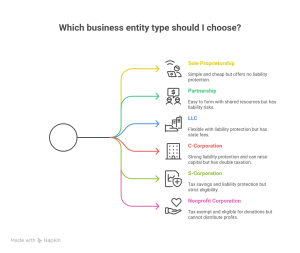
Choosing the Right Business Entity: A Guide for New Entrepreneurs

Starting a business is exciting—you have the idea, the passion, and maybe even the customers lined up. But before you start selling, there’s an important decision you’ll need to make: what kind of business entity will your company be?

Your choice of business structure affects your taxes, your personal liability, your ability to raise money, and even how you eventually exit the business. Let’s walk through the most common business entity types, explain what they mean in plain language, and weigh the pros and cons of each.

choosing the correct business form by Nathan Moore, Nashville business attorney

1. Sole Proprietorship

A sole proprietorship is the simplest and most common way to start a business. It’s essentially just you doing business—no separate legal entity.

Pros:

  • Easy and inexpensive to set up.
  • Minimal paperwork and compliance requirements.
  • You keep all the profits.

Cons:

  • No liability protection—your personal assets (like your home or car) are at risk if the business gets sued or goes into debt.
  • Harder to raise money since investors and banks prefer more formal structures.
  • Business ends if you stop operating.

Best for: Freelancers, consultants, or very small businesses just testing the waters.

2. Partnership

If you’re going into business with one or more people, you may consider a partnership. Partnerships can be general partnerships (GP), where all partners share responsibility, or limited partnerships (LP)/limited liability partnerships (LLP), which give some partners limited liability.

Pros:

  • Easy to form, especially a general partnership.
  • Flexibility in dividing responsibilities and profits among partners.
  • Combined skills, resources, and capital.

Cons:

  • In a GP, each partner is personally liable for business debts and for the actions of other partners.
  • Potential for disputes if roles and expectations aren’t clearly defined.
  • Requires careful drafting of a partnership agreement to avoid conflicts.

Best for: Two or more people who trust each other and want to build something together without too much initial complexity.

3. Limited Liability Company (LLC)

An LLC combines the liability protection of a corporation with the flexibility of a partnership. It’s one of the most popular options for small and medium-sized businesses.

Pros:

  • Owners (called “members”) generally aren’t personally liable for business debts or lawsuits.
  • Flexible management structure—you can run it yourself or hire managers.
  • Profits can “pass through” to owners’ personal tax returns, avoiding double taxation.
  • Easier to bring in new members compared to a sole proprietorship or partnership.
  • LLCs can also elect to be taxed as an S-Corporation, which can provide additional tax advantages for certain owners.

Cons:

  • More expensive and paperwork-heavy to form than a sole proprietorship or partnership.
  • Some states charge annual fees or franchise taxes.
  • Rules and requirements vary by state, which can create complexity if you operate in multiple states.

Best for: Small to mid-sized businesses that want liability protection but still want flexibility and simplicity.

4. Corporation

A corporation is a separate legal entity from its owners (shareholders). Corporations come in two main types: C Corporations (C-Corps) and S Corporations (S-Corps).

C-Corporation

Pros:

  • Strongest liability protection.
  • Can raise money more easily through stock sales.
  • Perpetual existence—the corporation continues even if owners change.
  • Attractive to investors and venture capitalists.

Cons:

  • More expensive and complex to form and maintain.
  • “Double taxation”: the corporation pays taxes on its profits, and shareholders pay taxes again on dividends.
  • Requires ongoing compliance: annual meetings, minutes, and filings.

Best for: Businesses planning to scale significantly, seek outside investors, or eventually go public.

S-Corporation

Pros:

  • Pass-through taxation—profits are taxed at the shareholder level, avoiding double taxation.
  • Liability protection similar to a C-Corp.
  • Potential tax savings on self-employment taxes.

Cons:

  • Strict eligibility rules: limited to 100 shareholders, all must be U.S. citizens or residents.
  • More administrative requirements than an LLC.
  • IRS scrutiny—must pay owners a “reasonable salary” before distributing profits.

Best for: Small to medium businesses that want corporate liability protection with tax advantages.

5. Nonprofit Corporation

If your goal is charitable, educational, or religious rather than profit-driven, you might consider a nonprofit.

Pros:

  • Tax-exempt status if approved by the IRS.
  • Eligible for grants and donations.
  • Limited liability for directors and officers.

Cons:

  • Profits must be reinvested in the mission—cannot be distributed to owners.
  • Heavy compliance and reporting requirements.
  • Complex and lengthy application process for tax-exempt status.

Best for: Organizations formed to serve the public good rather than generate profit.

So, Which One Is Right for You?

There’s no one-size-fits-all answer. If you’re just starting small and want to test your idea, a sole proprietorship or partnership might make sense. If you want liability protection without too much red tape, an LLC is often a great choice. For businesses aiming for rapid growth and outside investment, a C-Corporation is usually the way to go. And if your mission is charitable, a nonprofit may be the right path.

The good news is that your choice isn’t permanent—you can change your business structure later as your company grows. The key is to pick the one that fits your goals, risk tolerance, and vision today.

Pro tip: It’s always smart to consult with a business attorney or accountant before making your final decision. They can help you understand how each option applies to your specific situation.

Frequently Asked Questions (FAQ)

Can I start as a sole proprietorship and change later?

Yes. Many entrepreneurs start as sole proprietors for simplicity and then transition to an LLC or corporation as the business grows and liability risks increase.

Is an LLC always the best choice for small businesses?

Not always. While LLCs offer liability protection and flexibility, some very small businesses may prefer the simplicity of a sole proprietorship, and others might benefit from electing S-Corporation status for tax purposes.

What’s the difference between an LLC and an S-Corporation?

An LLC is a legal entity created at the state level. An S-Corporation is a tax designation that either an LLC or corporation can elect, provided it meets IRS requirements. An LLC can choose to be taxed as an S-Corp, combining liability protection with potential tax savings.

Do I need a lawyer to form a business entity?

Not necessarily, but it’s highly recommended. While you can file forms online yourself, a lawyer ensures compliance with state laws, helps draft agreements, and tailors the structure to your goals.

Which business entity is best for raising venture capital?

C-Corporations are generally preferred by venture capitalists and investors because of their ability to issue different classes of stock and their perpetual structure.


Nathan Moore is a business attorney located in Nashville, Tennessee. Moore Law PC’s entire focus is helping advise and guide entrepreneurs and small business owners in their efforts to be successful in what they do.

Read More

What I Learned from Rodger Howell’s M&A Outlook at the ABA Spring Meeting

By Nathan Moore, Moore Law PC

At Moore Law PC, we’re always looking ahead—so attending the ABA Middle Market and Small Business Committee’s Spring Meeting in New Orleans this year was both a professional investment and a welcome reminder of how much opportunity still exists for our clients.

A highlight of the conference was a data-rich, insightful presentation by Rodger Howell, CEO of Houlihan Capital, on the state of middle-market M&A and private equity trends. As an attorney who works closely with business owners on growth, transition, and exit strategies, I found Rodger’s presentation incredibly valuable. Below, I share the key takeaways I’m now applying in my conversations with clients.

Market Conditions: Back to Normal, Not in Decline

Howell opened by addressing a common misconception: that M&A markets are “cooling off.” In truth, while dollar volumes have declined from the 2021 post-COVID surge, transaction volume remains robust—especially in the lower middle market.

2021 was an outlier, not the benchmark. The current climate reflects historical norms. For founders, that’s good news: you haven’t “missed the window.” You just need a clear strategy and the right advisors.

Private Equity: Flush with Capital, Focused on Fit

PE firms are still sitting on significant dry powder, but they’re more cautious about where and how they invest. Instead of chasing inflated deals, they’re favoring platform fits, recurring revenue models, and proven management teams.

One of the most promising trends for our clients is the rise of minority recapitalizations. These structures let owners sell a stake—often 20–40%—to raise growth capital while retaining control. It’s ideal for founders who want to scale without giving up the reins.

Rollover Equity: A Smart Way to “Double Dip”

Rodger highlighted how more deals now involve rollover equity—where a seller retains a partial stake post-transaction. This setup offers a potential second bite at the apple: founders get liquidity now and participate in the business’s future upside.

At Moore Law PC, we’re seeing increasing interest in this approach. It gives our clients flexibility, continued involvement, and the chance to benefit from value creation under new ownership or with capital infusion.

Understanding Valuation: Multiples Are Rational Again

Rodger’s valuation commentary was especially practical. Multiples are down from 2021 highs but stable and healthy—typically around 6x EBITDA for mid-market companies.

He emphasized the size premium: larger businesses receive higher multiples. That means smart investments in growth or acquisitions today can yield substantial value tomorrow. For clients with a $10M goal in mind, now is the time to think strategically about scale.

New Players: Family Offices and Independent Sponsors

Rodger explained that family offices and independent sponsors are now formidable buyers. These groups often bring longer-term outlooks and more flexible deal structures—especially valuable to founders concerned with legacy, culture, or operational continuity.

These buyers can be ideal partners for succession-minded owners or those in specialized sectors like cannabis or regulated industries where institutional capital hesitates.

The Role of Lawyers: Structure, Succession, and Strategy

Ultimately, Rodger reminded us of something we see daily at Moore Law PC: the biggest risks in a deal aren’t just financial—they’re human. Poor succession planning, unresolved family dynamics, or confusion between ownership and control can derail even a perfect offer.

Our role as legal counsel isn’t just to paper the deal—it’s to guide founders through a thoughtful process that respects their goals, protects their interests, and prepares them for what’s next.

Final Thoughts

Rodger Howell’s presentation confirmed what we’re already seeing on the ground: the middle market is active, evolving, and rich with opportunity. If you’re a business owner thinking about growth capital, succession, or exit planning, there’s no better time to start building your strategy.

At Moore Law PC, we help clients position themselves for success—whether that’s preparing for a sale, scaling to the next stage, or structuring ownership for long-term resilience.

If you’d like to discuss your options, we’re here to help.


Moore Law PC – Business Law for Growth, Transition, and Legacy.
Contact us today to learn more about how we support entrepreneurs and closely held businesses at every stage.

You can also download the PDF slides that accompanied this presentation.

Read More
Business expenses. What's legal?

What Business Expenses Are Tax-Deductible?

Being that it’s Black Friday, we thought this an appropriate time to discuss something a lot of business owners have questions about. What are tax deductible business expenses?

What Business Expenses Are Tax-Deductible? One of the advantages of running a business is that certain expenses can be deducted from your taxable income, reducing your overall tax burden. However, not all business costs qualify, and knowing which expenses are tax-deductible can help you maximize savings while staying compliant with tax regulations. Here’s a guide to understanding which business expenses can be deducted and how to ensure you’re taking advantage of all available deductions.

1. What Are Tax-Deductible Business Expenses?

Tax-deductible business expenses are ordinary and necessary costs incurred in the course of running a business. The IRS defines an “ordinary” expense as one that is common and accepted in your trade or business, while a “necessary” expense is one that is helpful and appropriate. These expenses can be subtracted from your business’s gross income, reducing the amount of income subject to taxation.

2. Common Tax-Deductible Business Expenses

There are several categories of expenses that most businesses can deduct from their taxable income:

Operating Expenses

Operating expenses are the routine costs required to keep your business running day-to-day. They include:

  • Rent or Lease Payments: If you lease office or retail space, the monthly rent is tax-deductible. This also applies to business storage space or equipment rentals.
  • Utilities: Essential services, such as electricity, water, gas, and phone and internet services, are deductible if they are used for business purposes.
  • Office Supplies and Expenses: Pens, paper, printer ink, and other small office supplies are fully deductible. Even large office-related purchases like computers, desks, and chairs can be deducted, though these may be treated as depreciable assets.

Employee and Contractor Expenses

Costs associated with employees and contractors can also be deducted, including:

  • Salaries and Wages: Salaries paid to employees (other than yourself as a sole proprietor) are generally deductible, as long as they are reasonable and necessary for the business.
  • Employee Benefits: Health insurance premiums, retirement contributions, and other employee benefits are tax-deductible, which can help reduce your taxable income while attracting and retaining talent.
  • Contractor Payments: Payments to independent contractors are deductible, as long as you report them correctly using Form 1099-NEC.

Professional and Legal Fees

Fees paid to accountants, attorneys, and other professionals for business services are deductible. For example:

  • Tax Preparation Fees: Fees for preparing your business’s tax return, whether done by an accountant or through software, are deductible.
  • Legal and Consulting Fees: Legal expenses related to business operations, contracts, or compliance can be deducted as business expenses, though legal costs related to personal matters are not.

Marketing and Advertising Costs

Marketing and advertising expenses are generally deductible, including:

  • Website and Social Media Costs: Website design, hosting fees, and online advertising on platforms like Google or Facebook are deductible as business expenses.
  • Print Advertising: Traditional advertising methods, like brochures, business cards, and newspaper ads, also qualify for deductions.
  • Promotional Events and Sponsorships: Costs related to sponsoring events, hosting promotional activities, or supporting local causes in exchange for advertising are tax-deductible.

Travel and Meal Expenses

Some travel and meal expenses are deductible if they are directly related to your business:

  • Business Travel: If you travel for work, such as to attend conferences, meet clients, or explore new markets, transportation costs (airfare, rental cars, public transportation), lodging, and meals are deductible.
  • Meals and Entertainment: Business meals with clients or team members are usually 50% deductible, but they must be directly related to business operations. Entertainment expenses are no longer deductible under recent tax law changes.

Depreciation of Assets

Depreciation allows you to deduct the cost of certain business assets over time, rather than all at once. Deductible depreciable assets include:

  • Vehicles Used for Business: If you use a vehicle primarily for business purposes, you can deduct expenses such as gas, maintenance, and depreciation based on the percentage of business use.
  • Machinery and Equipment: High-cost items, like heavy machinery or office furniture, can be depreciated over their useful life, allowing you to deduct part of the asset’s cost each year.
  • Real Estate and Improvements: If you own property used exclusively for business, depreciation deductions are available for the cost of the building itself, though not for the land.

Business Insurance

Insurance premiums for policies necessary to run your business are deductible. This includes:

  • Liability Insurance: Coverage to protect against claims of property damage, injury, or negligence is a tax-deductible business expense.
  • Workers’ Compensation: If required by law in your state, workers’ comp insurance premiums are fully deductible.
  • Business Interruption Insurance: This coverage helps recover lost income due to events like natural disasters and is deductible as a business expense.

Research and Development (R&D)

If your business engages in research and development activities, you may be eligible to deduct R&D costs. These costs include:

  • Materials and Supplies for R&D Projects: Expenses associated with developing new products or technologies are deductible.
  • Employee Costs for R&D: Wages paid to employees involved in R&D projects can be included in your deductions.

Interest on Business Loans

Interest paid on loans or credit used for business purposes is deductible, provided the funds were used directly in your business. This includes:

  • Business Loan Interest: Interest on loans taken out to fund business activities or equipment purchases.
  • Credit Card Interest: If you use a credit card solely for business purchases, the interest on those purchases is deductible.

Education and Training

Educational expenses directly related to your business or industry are also deductible, including:

  • Workshops and Conferences: Registration fees for conferences or seminars that enhance your skills or business knowledge.
  • Continuing Education: Courses, certifications, or training that directly relate to improving job skills or enhancing business knowledge qualify as tax-deductible.

3. Home Office Deduction

If you operate a business out of your home, you may qualify for the home office deduction. The IRS allows two methods:

  • Simplified Method: Deduct $5 per square foot of office space, up to a maximum of 300 square feet.
  • Actual Expense Method: Deduct a percentage of your home expenses (e.g., mortgage interest, rent, utilities) based on the square footage used for business.

To qualify, the office space must be used exclusively and regularly for business purposes.

4. Other Potential Deductions

There are many other expenses that may qualify as deductible, depending on the nature of your business, including:

  • Business Licenses and Permits: Fees for licenses, permits, and other required business certifications.
  • Membership Dues: Memberships in professional organizations or trade associations related to your business.
  • Software and Technology Subscriptions: Monthly fees for essential business software, such as accounting software, are generally deductible.

5. How to Track and Document Your Deductions

Maintaining accurate records is crucial to substantiate deductions in the event of an audit. Here are some best practices:

  • Keep Receipts and Invoices: Organize receipts and invoices for every business-related expense to back up your deductions.
  • Use Accounting Software: Many business accounting platforms help track expenses and categorize them for tax purposes, simplifying reporting.
  • Separate Business and Personal Expenses: Use a dedicated business bank account and credit card to keep business expenses separate from personal ones, reducing confusion and supporting accurate record-keeping.

6. Consult a Tax Professional

While many common expenses qualify for deductions, tax laws change regularly, and not all costs may apply to your specific business. A tax professional can provide guidance on industry-specific deductions, help you avoid audit risks, and ensure you’re fully leveraging all available deductions.

Conclusion

Understanding which business expenses are tax-deductible can make a significant difference in reducing your taxable income and improving cash flow. Deducting legitimate business expenses—such as operating costs, employee wages, professional fees, and travel expenses—helps lower your tax liability and keep more money in your business. Accurate record-keeping and consulting with a tax professional can ensure that you’re taking advantage of all available deductions and staying compliant with IRS guidelines.

Read More
licensing intellectual property

How Do I License Intellectual Property to Others?

Licensing intellectual property (IP) can be a powerful way to generate revenue, expand brand reach, or collaborate with other businesses. Whether it’s a patent, trademark, or copyrighted material, licensing allows you to retain ownership of your IP while granting others permission to use it under specific conditions. By understanding the different types of licenses and knowing how to structure licensing agreements, you can make the most of your intellectual property while protecting your rights.

1. What Does it Mean to License Intellectual Property?

Licensing intellectual property is the process of granting another party permission to use your IP rights under agreed terms. As the IP owner (licensor), you maintain ownership, while the licensee gains specific usage rights, which can include manufacturing, distribution, branding, or reproduction of the IP.

Licensing can apply to various types of intellectual property:

  • Patents: Licensees may pay to manufacture or sell a patented invention.
  • Trademarks: Brands may license trademarks, allowing others to use logos or brand names for specific products or services.
  • Copyrights: Authors, musicians, and software developers can license their work for use in various media, including print, film, or digital platforms.

2. Types of IP Licenses

The type of license you choose depends on the level of control and exclusivity you want to grant the licensee. Common types of IP licenses include:

  • Exclusive License: Grants the licensee sole rights to use the IP within a specific territory or field, even excluding the licensor. This type of license is usually more expensive, as the licensee is guaranteed they’ll be the only one with rights to the IP in that context.
  • Non-Exclusive License: Allows the licensor to license the IP to multiple parties simultaneously. Non-exclusive licenses are common in software, media, and technology, where multiple users may benefit from the same IP.
  • Sublicensable License: Permits the licensee to sublicense the IP to other third parties. This arrangement is common in franchising, where franchisees may sublicense IP, like brand trademarks, to their individual locations.
  • Field-of-Use License: Restricts the licensee’s usage of the IP to a specific field or industry. For example, a patent holder might license their technology for use in the automotive industry but restrict usage in the medical field.
  • Territorial License: Limits the licensee’s rights to a specific geographic area. This license can help licensors maintain control over where their IP is used or marketed.

3. Benefits of Licensing Your IP

Licensing your intellectual property offers several potential benefits:

  • Revenue Generation: Licensing fees or royalties provide ongoing income without the need for extensive additional work. The licensor can monetize their IP while allowing the licensee to use it for profit.
  • Market Expansion: Licensing can help your brand, product, or technology reach new markets without the costs associated with direct expansion. For example, licensing a trademark to a manufacturer in another country allows for broader distribution.
  • Brand Recognition: Trademark licensing can increase brand visibility and consumer recognition, especially when licensees operate in different regions or industries.
  • Reduced Liability and Maintenance Costs: Licensing lets you share production and distribution responsibilities with the licensee, which reduces operational burdens and limits exposure to liabilities related to manufacturing or marketing.

4. Creating a Licensing Agreement

A licensing agreement is a legal contract that defines the terms and conditions under which the licensee can use the IP. A well-structured agreement protects your interests and provides a clear framework for the licensee’s rights and obligations. Key elements of a licensing agreement include:

  • Scope of the License: Clearly define what rights you are granting. This section should specify the type of license (e.g., exclusive, non-exclusive), the allowed uses, and any restrictions on use.
  • Duration: Set the period during which the license is valid. Licensing agreements can be temporary, renewable, or ongoing. Having a set end date gives you flexibility to renegotiate terms or find new licensing partners.
  • Territory: Specify where the licensee is permitted to use the IP. Geographic limitations can protect your interests in certain regions or allow you to license the IP to different parties in various locations.
  • Royalty Structure and Payment Terms: Outline how you’ll be compensated for the license. Licensing fees may be structured as a lump-sum payment, recurring royalty based on sales, or percentage of revenue generated from the IP. Be clear on payment terms and any minimum royalty guarantees.
  • Quality Control and Compliance: If licensing a trademark, for example, you may require certain quality standards to ensure your brand reputation is maintained. Quality control provisions help protect the brand’s image and ensure the licensee’s products or services align with your standards.
  • Termination Clauses: Define conditions under which either party can terminate the agreement, such as breach of contract, failure to meet sales targets, or bankruptcy. Including termination provisions ensures you retain control over the IP if issues arise.
  • Sublicensing and Transfer Rights: If you allow the licensee to sublicense or transfer their rights, this should be explicitly stated. Otherwise, their rights should be restricted to prevent unauthorized sublicensing.

5. How to License Your IP Step-by-Step

Licensing intellectual property can be complex, but following a step-by-step approach can help streamline the process:

Step 1: Assess the Value and Potential Market for Your IP

Understand the potential revenue and benefits your IP could generate for licensees, and identify target industries or companies that may benefit from licensing it.

Step 2: Decide on the Type of License

Determine the level of exclusivity, territory, and duration that make sense for your business. Consider whether you’re open to sublicensing or limiting the use to a particular field.

Step 3: Identify Potential Licensees

Look for companies, individuals, or organizations that align with your goals and can maximize the value of your IP. Research prospective licensees’ reputations, industry experience, and business models to ensure a good fit.

Step 4: Negotiate Terms

Negotiate key terms, such as royalties, duration, territory, and exclusivity. Be prepared to discuss payment structures, quality standards, and compliance requirements. Working with a legal professional during negotiations can help protect your interests.

Step 5: Draft and Finalize the Licensing Agreement

Once terms are agreed upon, draft a comprehensive licensing agreement. Ensure that both parties review and understand the document before signing. An attorney with IP experience can help draft a clear, enforceable agreement.

Step 6: Manage and Monitor the License

After the agreement is in place, maintain communication with the licensee to ensure compliance with the terms, quality standards, and payment schedules. Regular monitoring helps identify issues early and ensures both parties benefit from the agreement.

6. Common Challenges in Licensing IP

While licensing can be profitable, challenges can arise. Here are a few common obstacles:

  • Ensuring Compliance with Terms: Monitoring the licensee’s use of your IP can be challenging, especially in cases where quality standards or usage restrictions are in place. Regular audits or checks can help.
  • Royalties and Payment Issues: Some licensees may fail to report accurate sales figures or delay payments. Clear reporting guidelines and audit rights in the agreement can help mitigate these issues.
  • Protecting IP Rights: If a licensee misuses or infringes upon your IP, enforcing your rights may require legal action. Including indemnification clauses in the agreement can help protect you from legal issues related to misuse.

Conclusion

Licensing intellectual property allows you to leverage your creations without giving up ownership, creating opportunities for revenue generation, market expansion, and brand growth. By selecting the right type of license, drafting a solid licensing agreement, and carefully managing the relationship, you can maximize the value of your IP while ensuring that your interests are protected.

Licensing IP is a legal process, so consulting with an intellectual property attorney can be valuable when drafting or negotiating a licensing agreement. With the right approach and careful planning, licensing can be a powerful tool for unlocking the potential of your intellectual property.

Read More
What is the FMLA?

What is the Family and Medical Leave Act (FMLA), and Does it Apply to My Business?

The Family and Medical Leave Act (FMLA) is a federal law designed to protect the rights of employees who need time away from work for specific family or medical reasons. It provides eligible employees with up to 12 weeks of unpaid, job-protected leave within a 12-month period. FMLA allows workers to take time off without fear of losing their jobs or health benefits, helping employees balance their work responsibilities with personal or family health needs. If you’re a business owner, understanding FMLA requirements and determining whether they apply to your business is essential to ensure compliance and support a positive workplace.

1. What is the Purpose of the FMLA?

The FMLA was enacted in 1993 to protect employees who face family or medical situations that require them to take extended time away from work. The law provides eligible employees with up to 12 weeks of unpaid leave for qualifying reasons, including:

  • The birth and care of a newborn child
  • Adoption or foster care placement of a child
  • Care for an immediate family member (spouse, child, or parent) with a serious health condition
  • The employee’s own serious health condition that prevents them from performing their job
  • Certain military family leave requirements, such as preparing for deployment or caring for a family member injured in military service

2. How Does FMLA Protect Employees?

FMLA provides employees with job-protected leave, meaning that their job or an equivalent position is held for them during their absence. Additionally:

  • Health Benefits Continuation: Employers must continue to provide health insurance benefits under the same terms as when the employee was actively working.
  • Right to Reinstatement: Once the leave ends, employees are entitled to return to their original job or an equivalent role with the same pay, benefits, and responsibilities.

3. Does the FMLA Apply to My Business?

FMLA eligibility depends on several factors, including the size of your business and the number of employees.

  • Business Size Requirement: The FMLA applies to private-sector employers with 50 or more employees within a 75-mile radius. This employee count includes part-time and seasonal workers if they meet the weekly work-hour criteria.
  • Public Agencies and Schools: All public agencies, including federal, state, and local government employers, as well as public and private elementary and secondary schools, must comply with FMLA, regardless of the number of employees.

4. Employee Eligibility for FMLA

Even if FMLA applies to your business, not every employee will qualify for leave. For an employee to be eligible for FMLA benefits, they must:

  • Have Worked for the Employer for at Least 12 Months: The 12 months of employment do not need to be consecutive. For example, if an employee worked for you for nine months, left, and then returned for three months, they may still qualify.
  • Have Logged at Least 1,250 Hours in the Past 12 Months: Employees need to have worked a minimum of 1,250 hours in the year preceding their leave request. This typically equates to about 24 hours per week.
  • Work at a Location with 50 or More Employees Within a 75-Mile Radius: If your business has multiple locations, FMLA only applies if there are at least 50 employees within 75 miles of the employee’s worksite.

5. What Qualifies as a “Serious Health Condition” Under FMLA?

FMLA leave can be taken for a “serious health condition,” but not all health issues qualify. The Department of Labor defines a serious health condition as one that involves:

  • Inpatient Care: An overnight stay in a hospital, hospice, or residential medical care facility.
  • Chronic Conditions: Ongoing conditions that require periodic treatment, such as asthma, diabetes, or epilepsy.
  • Conditions Requiring Multiple Treatments: Certain illnesses or injuries may need multiple treatments over time, like cancer treatments or physical therapy.
  • Conditions that Incapacitate the Employee for More Than Three Consecutive Days: If an employee is unable to work for over three days and requires continuous treatment, the condition may qualify as serious under FMLA.

6. Types of FMLA Leave

Employees can take FMLA leave in a variety of ways to accommodate their needs and circumstances:

  • Continuous Leave: For an extended period, such as a full 12-week maternity leave.
  • Intermittent Leave: In smaller blocks of time for conditions that require periodic treatment. For example, an employee may take FMLA leave in half-day or full-day increments for ongoing treatment.
  • Reduced Schedule Leave: Allows an employee to reduce their usual work hours to accommodate medical treatments or recovery.

7. Employer Responsibilities Under the FMLA

If your business is covered by FMLA, you have several responsibilities as an employer to ensure compliance and protect employees’ rights:

  • Post FMLA Notices: You must post a notice outlining employee FMLA rights and responsibilities in a prominent place within the workplace.
  • Provide Notice of Rights and Responsibilities: When an employee requests FMLA leave, provide them with information about their FMLA rights, eligibility, and responsibilities, including medical certification requirements.
  • Respond Promptly to Leave Requests: After receiving an FMLA request, you should notify the employee about their eligibility within five business days. If they are eligible, you must also outline the specific expectations and obligations for the leave.
  • Track FMLA Usage: FMLA is limited to 12 weeks in a 12-month period, so it’s essential to track employees’ FMLA leave usage carefully to ensure they do not exceed their allowed time.
  • Continue Health Benefits During Leave: While an employee is on FMLA leave, you must maintain their group health benefits under the same terms as when they were actively working.

8. What if My Business is Not Subject to FMLA?

If your business has fewer than 50 employees or doesn’t meet other FMLA requirements, you are not legally required to provide FMLA leave. However, many small businesses voluntarily offer leave policies to attract and retain employees. Additionally:

  • Consider State Leave Laws: Some states have their own family and medical leave laws that may apply to smaller employers. Research your state’s laws, as some provide extended leave or benefits beyond FMLA.
  • Alternative Leave Policies: For businesses not covered by FMLA, implementing your own leave policies can enhance employee satisfaction and loyalty, even if it’s not required.

9. Consequences of FMLA Non-Compliance

Failure to comply with FMLA can result in serious consequences for your business. Non-compliance can lead to penalties, lawsuits, and damage to your business’s reputation. Employees may also file complaints with the Department of Labor, which can result in investigations and further legal repercussions.

Conclusion

The Family and Medical Leave Act (FMLA) provides vital protections for employees facing family and health-related challenges, but it also places specific responsibilities on employers. If your business has 50 or more employees or is a public agency, FMLA likely applies, and understanding the rules is essential for staying compliant and supporting your workforce.

For smaller businesses or those not covered by FMLA, state laws may still apply, and providing flexible leave options can offer employees peace of mind. FMLA compliance not only fulfills legal obligations but also contributes to a supportive and empathetic workplace culture, which can benefit employee morale and retention in the long run. Consulting with an employment law professional can also help ensure that your policies align with federal and state requirements, protecting both your business and your employees.

Read More
Tennessee contract lawyers

Do I need a written contract for every business deal?

When entering into a business agreement, it’s natural to wonder whether a formal, written contract is necessary for every deal. While not every transaction demands a detailed written contract, having one is often the best way to protect your business and avoid misunderstandings. Here’s a breakdown of why written contracts are beneficial, when they’re essential, and when a handshake or informal agreement might suffice.

1. What is a Written Contract?

A written contract is a formal document that lays out the details of an agreement between two or more parties. It typically includes information about each party’s obligations, deadlines, payments, and any terms that must be met to fulfill the agreement. Written contracts provide a clear, tangible record of what each party expects, minimizing the risk of miscommunication or disputes.

2. Why are Written Contracts Important?

Written contracts serve several critical purposes in business relationships:

  • Clarity and Specificity: Contracts define the specifics of each party’s responsibilities and expectations, reducing the chances of misunderstandings or disputes. For example, if one party expects payment by a certain date or delivery within a specific timeframe, these terms should be included in the contract.
  • Legal Protection: A contract acts as legally enforceable evidence if either party fails to fulfill its obligations. In the event of a dispute, a written contract can be a valuable asset in court, helping to prove the agreement’s terms and protect your interests.
  • Outlining Remedies for Breach: Contracts often include provisions for what happens if one party doesn’t meet their obligations, such as penalties, damages, or termination clauses. This clarity on what happens in case of a breach can save time and legal costs down the line.
  • Documentation of Changes: If either party wants to change the terms after the agreement is signed, a written contract makes it easy to document these adjustments, ensuring everyone remains on the same page.

3. When is a Written Contract Essential?

While not every business interaction requires a written contract, certain situations make having one crucial:

Large Financial Commitments or High-Stakes Deals

When a deal involves a significant financial commitment, a written contract is essential to protect your investment. Large transactions, such as sales of property or major product orders, can lead to costly mistakes or legal challenges if not handled with clear documentation.

Long-Term Agreements

Contracts covering extended time periods should always be documented in writing. This is especially true when agreements span months or years, as they are more prone to shifting conditions or terms that could be forgotten or contested later.

Intellectual Property and Confidentiality

If your deal involves intellectual property or proprietary information, a written contract is vital to protect these assets. Non-disclosure agreements (NDAs), intellectual property licenses, and confidentiality clauses are common in contracts involving sensitive information or technology.

Employment and Contractor Agreements

When hiring employees or independent contractors, written agreements help outline job duties, payment terms, deadlines, and company policies. These contracts also clarify the scope of work and intellectual property ownership, helping prevent disputes over what the contractor owns versus what belongs to the company.

Any Agreements with Regulatory Requirements

Some agreements, such as those involving real estate, lending, or certain sales, have legal requirements mandating a written contract. Failing to meet these requirements could void the agreement or lead to fines and legal complications.

4. Benefits of Written Contracts Over Verbal Agreements

While verbal agreements are legally binding in certain cases, they come with significant limitations:

  • Lack of Evidence: Verbal agreements are harder to prove. If a dispute arises, proving the exact terms of a verbal agreement can be challenging, especially if there are differing recollections of what was agreed upon.
  • Misunderstandings and Memory Issues: People may remember details differently or forget certain aspects over time. A written contract captures specifics that both parties can refer to later, reducing the risk of misinterpretation.
  • Court Enforceability: Courts are more likely to enforce written contracts since they provide clear, documented evidence. Verbal agreements often lack sufficient detail, making it difficult for courts to uphold them.

5. When Might a Written Contract Not Be Necessary?

In some cases, a written contract may not be essential, particularly for minor, low-risk transactions or informal relationships:

Low-Stakes, Low-Value Deals

If the transaction involves minimal risk or financial commitment, such as purchasing office supplies or one-time small services, a formal contract may not be necessary. While these small purchases are still transactions, the risk of loss is low enough that a written contract might not be worth the time and expense.

Established, Trust-Based Relationships

For recurring transactions between trusted parties, like long-term vendors or partners, some businesses may rely on an initial contract and later work on an informal basis. If both parties have consistently honored their agreements, they may feel comfortable proceeding without a new written contract each time.

Simple Transactions with Clear Terms

If the transaction is straightforward and can be documented with an invoice or receipt, a separate contract may not be needed. For example, buying stock products from a retailer usually doesn’t require a written contract, as the transaction terms are clear and documented in the receipt.

6. How to Decide if a Written Contract is Needed

Here are some questions to help determine whether a written contract is necessary:

  • What are the risks involved in the agreement? Higher financial risk or complexity usually calls for a written contract.
  • Is the transaction part of a long-term relationship? For ongoing relationships, an initial written contract may suffice with additional terms documented as needed.
  • Is there a legal requirement? Check for state or federal regulations that may require certain agreements to be in writing.
  • What are the consequences of a breach? If a breach would have significant financial or legal repercussions, it’s wise to document terms clearly in a contract.
  • Does the agreement involve sensitive information or intellectual property? Protecting confidential information is easier with a written contract that includes clear IP and confidentiality clauses.

Conclusion

While not every business deal requires a written contract, having one in place can provide clarity, legal protection, and peace of mind. For significant financial transactions, long-term agreements, or deals involving intellectual property or confidential information, a written contract is a vital asset. By documenting each party’s obligations and expectations, written contracts can help prevent misunderstandings, enforce terms in case of disputes, and support a more organized approach to business operations.

On the other hand, for small, low-risk, or one-time transactions, a handshake or verbal agreement may suffice, especially if the relationship is based on trust and established history. Ultimately, the decision depends on the nature of the transaction, the risk involved, and your comfort level with the other party. When in doubt, consulting a business attorney can provide guidance on when to formalize an agreement and help ensure you’re adequately protected.

Read More