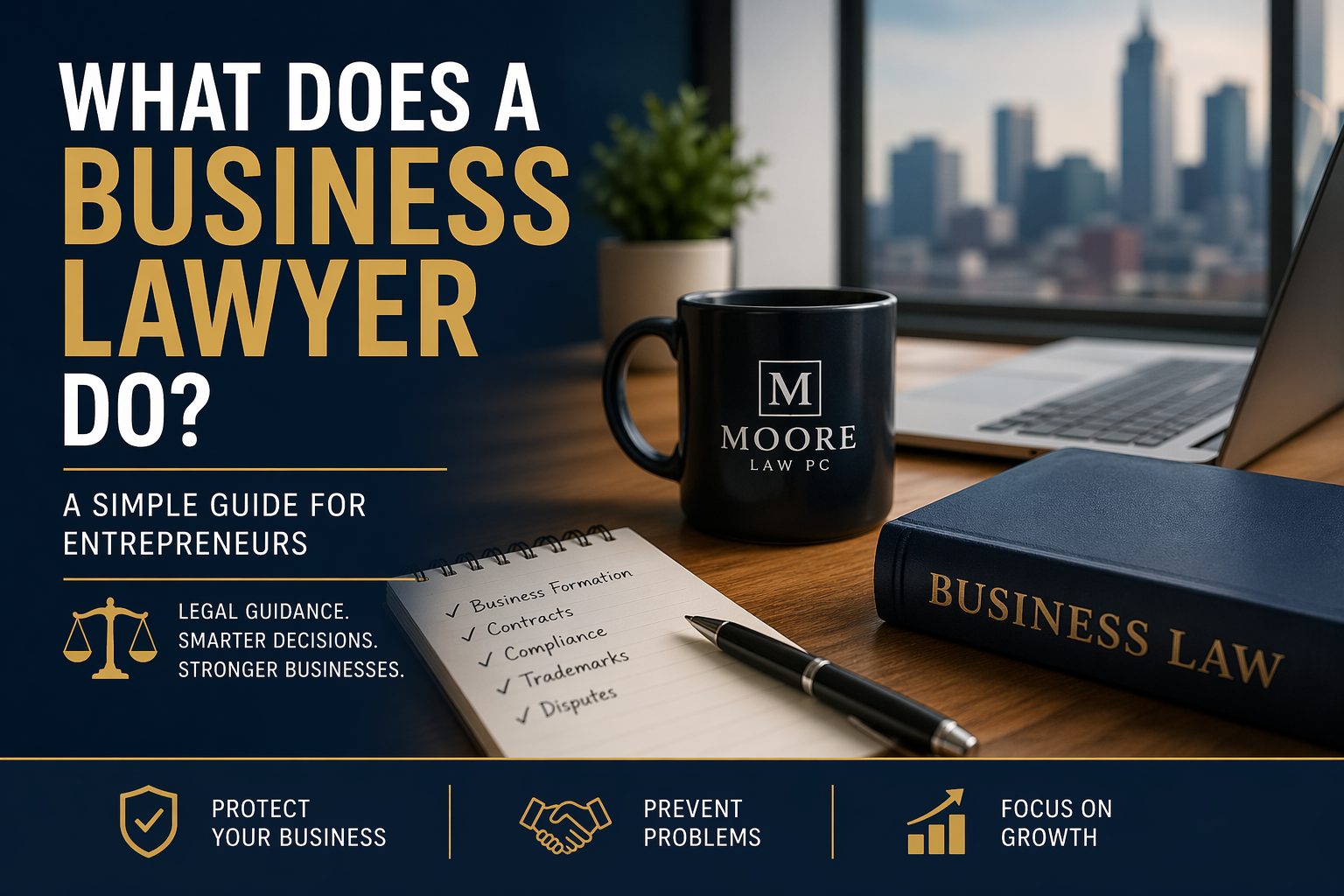
What does a business lawyer do – Nashville business attorney workspace with contracts, laptop, and legal guide

What Does a Business Lawyer Actually Do?

Starting a business is exciting—but legal mistakes early on can create expensive problems later. If you have ever wondered what a business lawyer does and whether you need one, this guide breaks it down in plain language.

Whether you are forming an LLC, launching a startup, or growing an established company, a business lawyer helps you make smart decisions, stay compliant, and protect what you are building.

Have questions about your business? Use the contact form on this page or call (615) 747-7467 to schedule your initial consultation.

What Is a Business Lawyer?

A business lawyer, also called a business attorney, helps individuals and companies handle legal issues related to starting, operating, and growing a business. The goal is to reduce risk, prevent avoidable problems, and help business owners move forward with confidence.

Instead of waiting until something goes wrong, many business owners work with a lawyer to make better decisions from the beginning.

What Does a Business Lawyer Actually Do?

1. Helps You Start Your Business the Right Way

One of the first decisions you will make is choosing a business structure. Should you form an LLC or a corporation? The answer depends on your goals, taxes, ownership plans, and risk level.

A business lawyer can help by:

  • Explaining your options in plain language
  • Recommending the right structure for your situation
  • Preparing and filing formation documents
  • Drafting operating agreements, bylaws, and other foundational records

Getting this part right can help protect your personal assets and create a stronger legal foundation for your business.

Not sure which structure fits your business? Reach out through the contact form or call (615) 747-7467 for an initial consultation.

2. Drafts and Reviews Contracts

Contracts are part of almost every business relationship. Clear agreements can prevent confusion, protect expectations, and reduce the chance of expensive disputes.

A business lawyer can:

  • Draft contracts tailored to your business
  • Review agreements before you sign
  • Negotiate stronger terms
  • Help protect your rights and limit unnecessary risk

Common examples include client agreements, vendor contracts, partnership agreements, licensing agreements, independent contractor agreements, and employment-related documents.

Before signing your next contract, contact Moore Law PC through this site or call (615) 747-7467 to get it reviewed.

3. Keeps Your Business Compliant

Business owners have to deal with ongoing legal requirements. Depending on the type of company, this may include registration issues, internal governance, employment policies, licensing, and state or federal compliance requirements.

A business lawyer helps you understand what applies to your company and what steps you need to take to stay on track.

  • State and federal compliance guidance
  • Business registrations and filings
  • Employment-related policies and procedures
  • Ongoing legal maintenance as your company grows

Avoid costly compliance issues—use the contact form or call (615) 747-7467 to schedule your consultation.

4. Protects Your Brand and Ideas

Your business name, branding, and original work can be some of your most valuable assets. A business lawyer can help you take steps to protect them.

  • Trademark registration
  • Brand protection strategy
  • Guidance on intellectual property issues
  • Help addressing misuse by competitors or others

Protecting your brand early can help you avoid conflicts and preserve the identity you are working hard to build.

Ready to protect your brand? Reach out through this page or call (615) 747-7467 to get started.

5. Helps Resolve Disputes

Even strong businesses can run into disagreements. These problems may involve partners, customers, vendors, employees, or other companies. A business lawyer helps you evaluate the issue, understand your options, and work toward a practical resolution.

This may include:

  • Demand letters and negotiation
  • Contract dispute analysis
  • Business tort and commercial dispute guidance
  • Litigation support when necessary

Dealing with a dispute? Contact Moore Law PC through the site or call (615) 747-7467 for guidance.

YouTube video

Do You Need a Business Lawyer?

Many business owners benefit from legal guidance long before there is a lawsuit or major problem. You may want to speak with a business lawyer if you are:

  • Starting a new business
  • Choosing between an LLC and a corporation
  • Entering into contracts
  • Bringing on a partner or investor
  • Hiring employees or contractors
  • Trying to protect a name, logo, or brand
  • Facing a business dispute
  • Planning for growth

Legal guidance is not just for emergencies. In many cases, it is one of the best ways to reduce risk and make better business decisions.

If you are unsure where to start, use the contact form or call (615) 747-7467 to schedule your initial consultation.

When Should You Hire a Business Lawyer?

The best time to hire a business lawyer is usually before you need one urgently. Working with a lawyer early can help you avoid common mistakes, save money over time, and build a stronger legal foundation.

Waiting until a problem becomes urgent often limits your options and increases the cost of fixing it.

Why Working with a Business Lawyer Matters

A business lawyer is not just someone to call when something goes wrong. The right lawyer can become a trusted advisor as your company grows, helping you make informed decisions, reduce legal exposure, and move forward with more confidence.

Start building your business on the right foundation—reach out through this page or call (615) 747-7467 today.

Start Your Business the Right Way

If you are ready to launch or strengthen your business, getting legal guidance early can make a real difference.

Use the contact form on this page or call (615) 747-7467 now to schedule your initial consultation.

Frequently Asked Questions

What does a business lawyer do in simple terms?

A business lawyer helps you start, run, and protect your business by handling legal matters such as formation, contracts, compliance, brand protection, and disputes.

Is a business lawyer necessary for an LLC?

A lawyer is not legally required to form an LLC, but working with one can help you choose the right structure, prepare proper documents, and avoid costly mistakes.

When should I hire a business attorney?

It is usually best to hire a business attorney before you sign important contracts, bring on partners, hire workers, launch a new venture, or face a dispute.

Can a business lawyer help with contracts?

Yes. A business lawyer can draft, review, revise, and negotiate contracts to help protect your interests and reduce the risk of future disputes.

Can a business lawyer help protect my brand?

Yes. Business lawyers often help with trademark registration, brand strategy, and other legal steps that protect the name and identity of your company.

About the Author — Nathan Moore, Attorney at Law

Nathan Moore is the founder of Moore Law PC, a business law firm based in Nashville, Tennessee. He has practiced law for more than twenty years, helping entrepreneurs and companies with trademark registration, business formation, contracts, and commercial disputes.

Have questions or need legal help? Use the contact form on this page or call (615) 747-7467 to schedule your initial consultation.



Read More

A New Era at the SEC? My Takeaways from Hester Peirce’s Candid Discussion

Hester Peirce, SEC Commissioner

I love attending the American Bar Association Business Law conferences. The networking, learning, and programming are unmatched.

At the Venture Capital Committee meeting, I was able to attend a Q&A session with SEC Commissioner Hester Peirce, which was was both refreshing and thought-provoking. Commissioner Peirce, known for her candid approach to innovation and regulation, covered a wide range of topics — with a particular focus on crypto regulation, disclosure reforms, and the future of U.S. capital markets.

Here’s what stood out to me.

A Reset in Crypto Policy
Commissioner Peirce made it clear: the SEC is trying to “reset” its approach to crypto. Instead of regulating by enforcement alone, the goal is to provide real, viable pathways for innovators to comply with existing laws. Peirce emphasized clearer jurisdictional boundaries, engagement with other agencies, and the hope for long-term legislative solutions to settle gray areas.

She discussed ongoing work within the SEC’s crypto task force, which is developing no-action letters, rule proposals, and guidance around tricky areas like stablecoins, custody, staking, and non-fungible tokens (NFTs). There’s also an openness to industry input — something she encouraged repeatedly.

The bottom line: the SEC is trying to move from ambiguity toward practical clarity, though it remains a slow and careful process.

Disclosure — A Common Ground
One of the sharpest points came when Peirce spoke about disclosures for digital assets. Whether an asset is classified as a security or falls under commodities rules, she argued that buyers need basic disclosures: Who’s behind the project? What are their plans? Are insiders holding large stakes?

The existing system, where enforcement actions fill the policy gap, is not sustainable. Instead, she wants upfront disclosures baked into the offering process — particularly for projects with a centralized development team. Once a project is truly decentralized, the disclosure need falls away.

It was refreshing to hear such a straightforward articulation of a principle many of us in the room agreed with.

Rethinking the Market Plumbing
Peirce also tackled a less flashy but vital topic: how the “plumbing” of financial markets could evolve. She described the potential for smart contracts and blockchain technology to streamline how securities are held, traded, and transferred — reducing settlement risks and cutting out unnecessary middlemen.

However, she warned that modernization must protect investors and maintain essential market functions like recordkeeping and voting. She favors principles-based regulation that can adapt over time rather than rigid rules that could quickly become outdated.

Her attitude seemed to strike the right balance: cautiously optimistic, but with both eyes open.

Private Markets and Accredited Investors
Beyond crypto, Commissioner Peirce turned to the growing dominance of private markets — and the concern that everyday investors are increasingly locked out. She called for revisiting the accredited investor definition, perhaps allowing people to qualify based on knowledge or professional experience rather than just wealth. The current requirements to be considered an accredited investor are either 1) having a $200k / year income ($300k if joint), or 2) a net worth of $1 million (excluding one’s home). Clearly, neither of these necessarily indicates a level of sophistication sufficient to determine risks associated with investment in unregistered, illiquid, and non-public securities. The current requirements incorrectly (in my view, and Commissioner Peirce’s) imply this sophistication, when the only way to truly pass the threshold of understanding is through education, which can be achieved independent of personal wealth or income.

Peirce sees a future where more retail investors can participate in early-stage growth companies, provided the right protections are in place. She stressed that regulation should not ossify around incumbents but should leave room for challengers and innovation. Changing the accredited investor requirements also expands the pool of usable capital.

Again, her remarks reflected a real awareness of how markets are changing — and a willingness to rethink traditional barriers.

Enforcement: A Needed Course Correction
Finally, Peirce addressed one of the elephants in the room: the SEC’s prior reliance on enforcement actions to set crypto policy. She acknowledged that using enforcement to shape law was an “unorthodox” and problematic approach. The new focus is on stepping back, writing better rules, and using the knowledge gained from enforcement teams constructively — without letting it drive policy by default.

For anyone worried about regulatory overreach, this was an encouraging signal.

Final Thoughts
As an attendee, I left the session with cautious optimism. Commissioner Peirce struck me as a regulator who truly values innovation, understands nuance, and isn’t afraid to admit when systems need fixing.

The SEC has enormous challenges ahead — from crypto to AI to revitalizing the public markets — but voices like Peirce’s give reason to believe that better days, and smarter rules, could be coming.

I’ll be watching closely to see how many of these ideas take root.

Read More
capital investment and business loans

What Are the Legal Requirements for Raising Capital or Obtaining a Loan?

Raising capital or obtaining a loan is often a crucial step for businesses, whether you’re just starting out or looking to expand. But before you dive into securing funds, it’s essential to understand the legal requirements that come with raising capital or taking out a loan. This process can involve complex regulations, and failing to follow the rules could lead to serious legal and financial consequences.

In this blog post, we’ll break down the legal requirements you need to be aware of when raising capital or obtaining a loan, all in plain language that anyone can understand—whether you’re a new entrepreneur or an experienced business owner.

Raising Capital: What You Need to Know

Raising capital means obtaining money to fund your business by selling equity (ownership in the company) or taking on debt. Many businesses raise capital by selling stock, taking on investors, or issuing bonds. If you’re considering raising capital through equity or debt financing, there are specific legal steps you’ll need to follow.

1. Understand Securities Laws

When you raise capital through equity financing (selling shares in your business), you’ll likely be dealing with securities laws. Securities laws exist to protect investors and ensure transparency in financial markets. In the U.S., the Securities and Exchange Commission (SEC) regulates the sale of securities.

Here’s what you need to know about securities laws:

  • Registering with the SEC: If you’re raising capital by selling shares, you may be required to register with the SEC. However, many small businesses qualify for exemptions from full registration. For example, the SEC’s Regulation D allows certain businesses to raise money without the need for a public offering.
  • Private Placements and Exemptions: If you don’t want to go through the full registration process, you might qualify for a private placement exemption. This allows you to sell shares to accredited investors (wealthy individuals or institutions) without needing to register your securities with the SEC. Each exemption has specific requirements, so it’s essential to understand which rules apply to your business.
  • State Blue Sky Laws: In addition to federal laws, each state has its own securities regulations known as Blue Sky laws. These laws are designed to protect investors from fraud and ensure transparency. You’ll need to comply with both federal and state regulations when raising capital.
  • Disclosure Requirements: Whether you’re registering with the SEC or qualifying for an exemption, you must provide accurate and complete information about your business to potential investors. This includes detailed financial statements, a description of your business’s risks, and other relevant information. Transparency is key—failing to disclose important details can lead to legal trouble.

2. Issuing Stock or Equity

If you plan to raise capital by selling shares of your company, it’s important to follow the correct legal procedures:

  • Create a Shareholder Agreement: When issuing stock to investors, you should create a shareholder agreement. This legal document outlines the rights and obligations of both the company and its shareholders. It covers topics like voting rights, dividend policies, and the process for transferring shares.
  • Cap Table Management: As you sell shares, it’s important to keep an accurate cap table (capitalization table), which tracks the ownership percentages of all shareholders. This document helps ensure transparency and legal compliance when managing your company’s equity.
  • Corporate Governance: If you’re raising capital through equity, your company’s structure and governance must comply with corporate law. This involves establishing a board of directors, holding regular shareholder meetings, and maintaining accurate records of corporate decisions.

3. Protecting Your Investors

When raising capital, you have a legal duty to protect your investors. This includes:

  • Fiduciary Duty: As a business owner or executive, you have a fiduciary duty to act in the best interest of your shareholders. This means making decisions that are fair, transparent, and designed to benefit the company and its investors.
  • Anti-Fraud Laws: The SEC enforces anti-fraud laws, which prohibit businesses from misleading investors or providing false information. Failing to disclose material facts or engaging in deceptive practices can result in severe penalties, including fines or even jail time.

Obtaining a Loan: What You Need to Know

If you’re not ready to sell equity or you prefer not to, obtaining a loan is another common way to raise capital. Loans involve borrowing money from a lender (such as a bank or investor) and paying it back with interest. While obtaining a loan is generally more straightforward than raising capital through equity, there are still important legal requirements to be aware of.

1. Understand the Loan Agreement

A loan agreement is a legally binding contract between you and the lender. It outlines the terms of the loan, including the amount borrowed, interest rate, repayment schedule, and any penalties for defaulting on the loan. Make sure to:

  • Read the Agreement Carefully: Review the loan agreement carefully before signing it. Ensure that you understand the terms, including the interest rate, repayment schedule, and any additional fees.
  • Negotiate Terms: In some cases, you may be able to negotiate the terms of the loan with the lender. This can include negotiating a lower interest rate, adjusting the repayment schedule, or reducing fees.
  • Collateral: Some loans may require collateral (assets such as property or equipment) to secure the loan. If you default on the loan, the lender has the right to seize the collateral.

2. Comply with Banking and Lending Laws

Lenders, including banks, are regulated by strict banking and lending laws designed to protect borrowers. When you apply for a loan, these regulations ensure that lenders treat you fairly and that the loan terms are transparent. Some legal considerations include:

  • Truth in Lending Act (TILA): This federal law requires lenders to disclose important information about the loan, such as the annual percentage rate (APR) and the total cost of the loan, before you sign the agreement. This transparency helps ensure that borrowers fully understand the terms they’re agreeing to.
  • Equal Credit Opportunity Act (ECOA): This law prohibits lenders from discriminating against borrowers based on race, religion, gender, age, or other protected characteristics. It ensures that all borrowers have an equal opportunity to obtain credit.
  • State Lending Laws: In addition to federal regulations, each state has its own lending laws that regulate loan terms, interest rates, and protections for borrowers. Make sure to understand your state’s specific lending requirements before applying for a loan.

3. Maintain Good Financial Records

When you apply for a loan, lenders will typically ask for detailed financial records to evaluate your ability to repay the loan. Make sure your business has up-to-date and accurate financial statements, including:

  • Balance Sheet: Shows the company’s assets, liabilities, and equity.
  • Income Statement: Provides an overview of the company’s revenue and expenses.
  • Cash Flow Statement: Demonstrates how much cash is flowing in and out of the business.

Having organized financial records not only helps you secure a loan but also keeps your business in good financial health.

Final Thoughts

Raising capital and obtaining loans are essential parts of growing a business, but they come with legal requirements that should not be overlooked. Whether you’re raising funds through equity or debt financing, understanding and complying with securities laws, lending regulations, and your fiduciary duties to investors will help you avoid legal issues and protect your business.

If you’re unsure about the legal requirements for raising capital or obtaining a loan, it’s always a good idea to consult with an attorney or financial advisor. They can guide you through the process and ensure that your business stays compliant with all applicable laws and regulations, allowing you to focus on building and growing your company.

Reach out to us today to schedule you free business consultation.

Read More